Blogs
Can Discoms Deny Electricity in "Unauthorized" Colonies? High Court Ruling & Legal Remedies for Property Owners
Can Discoms Deny Electricity in "Unauthorized" Colonies? High Court Ruling & Legal Remedies for Property Owners
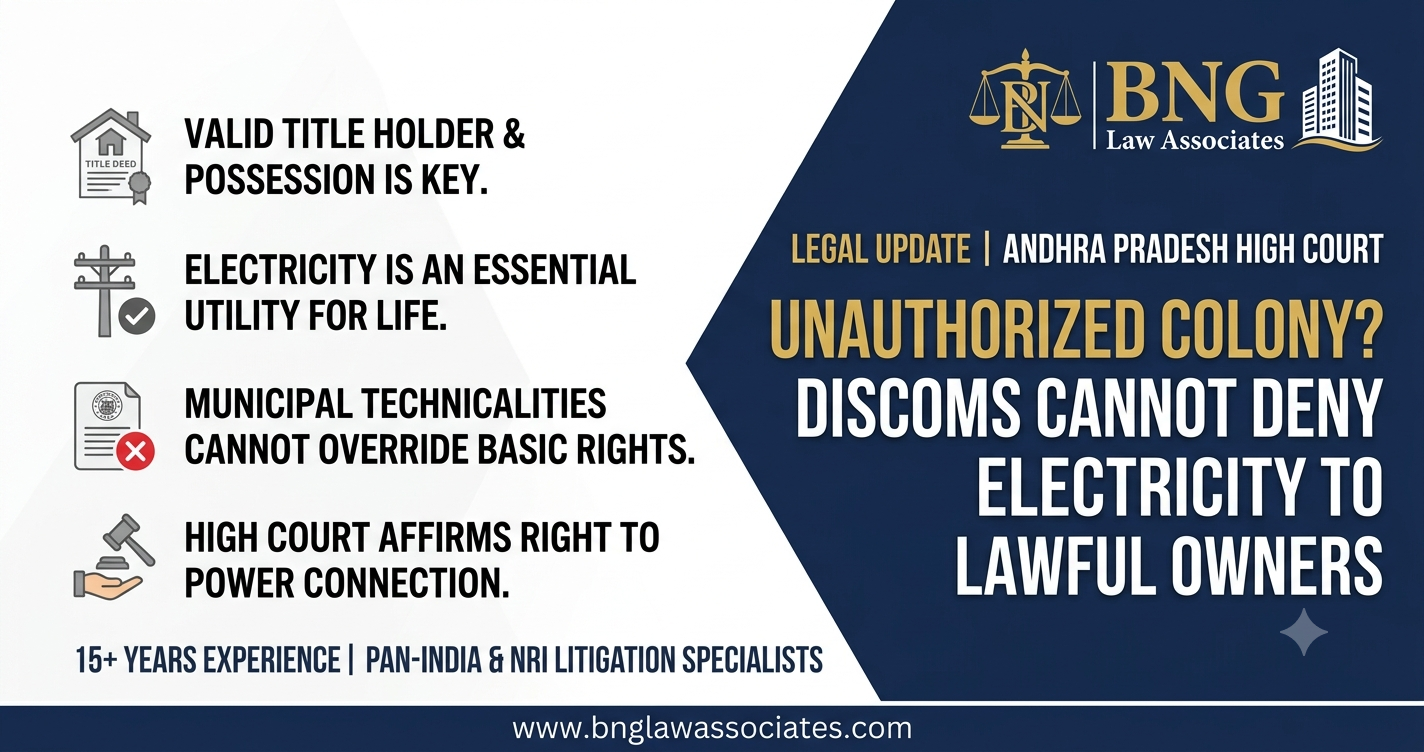
Access to basic utilities—such as electricity and water—forms the bedrock of property ownership and peaceful occupation in India. However, property owners and non-resident Indian (NRI) real estate investors frequently encounter severe administrative hurdles, particularly when local municipal authorities or electricity distribution companies (Discoms) refuse service connections under the pretext that a layout, colony, or structure is "unapproved" or "unauthorized." In a landmark decision, the High Court of Andhra Pradesh has ruled that electricity distribution companies cannot arbitrarily deny an electricity service connection to a lawful occupant or title holder merely because the surrounding layout or colony lacks formal municipal approval. This ruling strongly reinforces established constitutional jurisprudence: electricity is an essential facet of the Right to Life under Article 21 of the Constitution of India, and municipal layout disputes cannot be weaponized by utility providers to deprive lawful owners of essential amenities. Key Legal Principles Established by the High Court 1. Title and Lawful Possession Supersede Layout Technicalities The High Court emphasized that Discoms are statutory service providers, not municipal enforcement bodies. When an applicant establishes valid title (through registered sale deeds, gift deeds, or conveyance instruments) and lawful physical possession, the Discom is duty-bound under the applicable Electricity Supply Code to grant a power connection. 2. Electricity as a Constitutional & Statutory Right Under Section 43 of the Electricity Act, 2003, every distribution licensee has a statutory duty to supply electricity to any owner or occupier of a premises upon receiving a valid application. The High Court reiterated that access to electricity is intrinsically tied to human dignity and modern existence under Article 21 of the Constitution. 3. Administrative Boundary Between Discoms and Municipal Bodies Discoms cannot step into the shoes of urban development authorities (such as DDA, HUDA, or municipal corporations) to judge layout legality. Supplying an electricity connection does not confer legal regularisation on an unapproved layout, nor does it preclude municipal bodies from taking lawful action under planning acts. Consequently, Discoms have no legitimate basis to deny connection requests on planning grounds alone. Practical Implications for Property Owners & NRI Investors Property disputes involving unapproved colonies, regularisation policies, and utility access are particularly challenging for High-Net-Worth Individuals (HNIs) and NRI property owners who manage real estate portfolios remotely. Common challenges include: Tenant & Possession Disputes: Inability to secure power connections often degrades property valuation and leads to tenancy friction. Coercive Administrative Delays: Local power boards frequently issue informal refusals without providing written statutory reasons. Risk of Encroachment: Vacant or under-utilised properties in unapproved layouts remain vulnerable to encroachment if essential utility infrastructure is stalled. Strategic Legal Remedies: How BNG Law Associates Secures Your Utility Entitlements When facing arbitrary refusal or inaction from Discoms, property owners should adopt a systematic legal approach: Formal Statutory Demand Notice: Submit a structured legal representation citing Section 43 of the Electricity Act, 2003 along with proof of title/possession. Filing Before the Consumer Grievance Redressal Forum (CGRF): Exhaust statutory remedies before the Ombudsman where administrative delays occur. Writ Jurisdiction Before the High Court (Article 226): In cases of persistent refusal, BNG Law Associates drafts and institutes Writ Petitions before the High Court to secure immediate directions (Mandamus) against the Discom. Why BNG Law Associates? With over 15+ years of core litigation experience, BNG Law Associates serves as panel-grade legal advisors to major corporations, institutional clients, and global NRIs across Delhi NCR and PAN India. Our team provides end-to-end legal intervention, combining deep constitutional law expertise with modern technology-driven, remote legal solutions for foreign nationals and NRIs. Virtual Consultations: Seamless video conference sessions (Zoom/Teams) tailored for overseas clients. PAN-India Execution: Complete litigation management from local tribunals up to the High Courts and Supreme Court of India. Facing Property or Utility Disputes in India? Consult our senior legal panel for strategic advice and litigation support. 🌐 Website: www.bnglawassociates.com 📍 Primary Office: Delhi NCR | PAN India & International NRI Support 📧 Contact: Reach out via our website portal to schedule a virtual legal strategy session.