Blogs
Proving a Will in India: Analyzing the Supreme Court’s Three-Point Evidentiary Test for NRI Property Disputes
Proving a Will in India: Analyzing the Supreme Court’s Three-Point Evidentiary Test for NRI Property Disputes
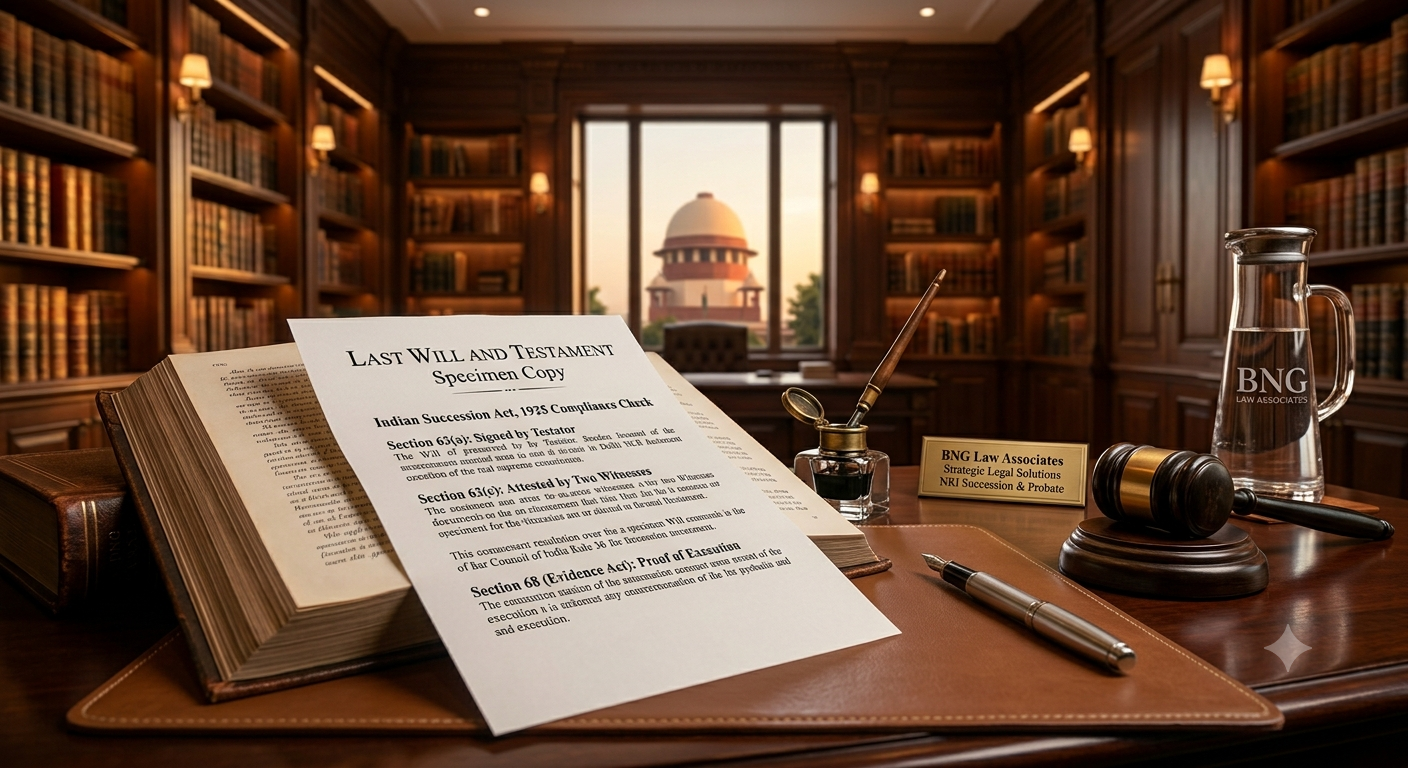
Proving a Will in India: Analyzing the Supreme Court’s Three-Point Evidentiary Test for NRI Property Disputes For Non-Resident Indians (NRIs) managing ancestral estates and corporate entities protecting high-value commercial properties in Delhi NCR, an ambiguous or contested Will can trigger decades of grueling litigation. A frequent misconception among property owners is that a registered Will is entirely immune to legal challenges. However, the apex court has repeatedly clarified that registration does not automatically absolve a Will from strict judicial scrutiny. Because a Will is a unique document that takes effect only after the death of the testator—meaning the author is no longer available to confirm its validity—the legal thresholds for proving its authenticity are exceptionally high. To survive a legal challenge, a Will must clear a strict 3-point evidentiary test governed by Section 63 of the Indian Succession Act, 1925, and Section 68 of the Indian Evidence Act, 1872. The 3-Point Evidentiary Test Explained 1. Mandatory Dual Attestation Under Section 63(c) of the Indian Succession Act, a Will cannot be executed by the testator alone. It is a mandatory statutory requirement that the Will be signed and attested by at least two independent attesting witnesses. A document lacking dual attestation fails the very first threshold of legal validity. 2. Simultaneous Execution and Acknowledgment The law requires a specific sequence of execution. The attesting witnesses must have: Personally seen the testator sign or affix their mark to the Will, OR Received a personal acknowledgment of the signature directly from the testator. Furthermore, each witness must sign the Will in the absolute presence of the testator, creating an unbroken chain of simultaneous execution. 3. Proving Execution in the Witness Box This is where most estate litigation is won or lost. Under Section 68 of the Indian Evidence Act, a Will cannot be used as evidence in court unless at least one attesting witness is examined in the witness box. This witness must testify under oath to confirm two critical facts: That the testator signed the document voluntarily in their presence. That the testator was of sound mind, fully understanding the nature and consequences of the disposition at the exact time of execution. Strategic Legal Note: If the attesting witnesses have passed away or cannot be found, the law permits secondary evidence under Section 69 of the Evidence Act, requiring proof that the witness's attestation is in their handwriting and that the signature of the testator is in the testator's handwriting. However, this demands sophisticated forensic and circumstantial documentation. Dispelling the Myth of the "Registered Will" While registration under the Registration Act, 1908, adds a layer of official credibility, the Supreme Court has consistently held that registration does not inherently cure a Will of "suspicious circumstances." If a propounder (the person relying on the Will) takes an active part in its execution, if natural heirs are unexplainedly cut off, or if there are unexplained alterations in the document, the court will demand rigorous proof to satisfy its judicial conscience. The onus rests entirely on the propounder to dispel these suspicious circumstances. Seamless Legal Solutions for Global Clients Navigating complex succession laws and defending high-value real estate from thousands of miles away can be daunting. At BNG Law Associates, we bridge this geographical gap. Bringing 15+ years of institutional litigation excellence as panel-grade advocates, our firm operates a fully tech-enabled remote services framework. We routinely conduct strategic case assessments and coordinate complex litigation parameters for global NRI clients via secure Zoom, Microsoft Teams, and cloud-encrypted document pipelines. Our clients receive institutional-grade legal strategy without the logistical burden of international travel. Connect with Us Protect your family’s legacy and secure your ancestral holdings against probate challenges. Schedule a Consultation Office Location: Paschim Vihar, New Delhi, India.