Blogs
Institutional Content Standard: Supreme Court IT Act Ruling (Section 66 & Section 77B)
Institutional Content Standard: Supreme Court IT Act Ruling (Section 66 & Section 77B)
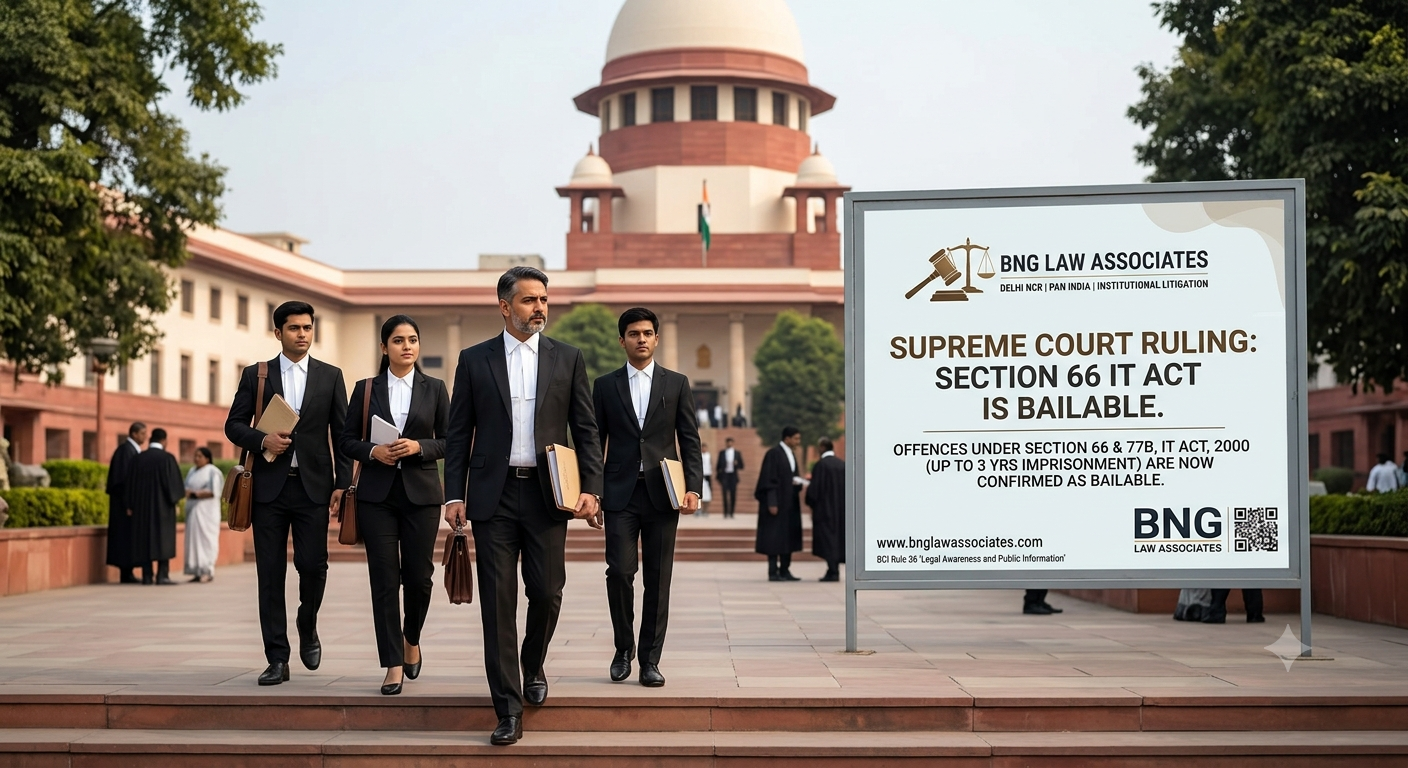
In a benchmark judgment (Maharaj Saran v. State of Punjab & Ors., 2026 LiveLaw (SC) 707), the Supreme Court of India has definitively settled a critical point of cyber jurisprudence: offences under Section 66 of the Information Technology Act, 2000, are bailable as a matter of law. Overruling a contrary interpretation by the Punjab & Haryana High Court, a Division Bench comprising Hon’ble Justice M.M. Sundresh and Hon’ble Justice Prasanna B. Varale clarified that courts must harmoniously read Section 66 alongside Section 77B of the IT Act. This ruling provides long-overdue clarity for corporate executives, tech professionals, and individuals facing unexpected cyber-allegations or Look Out Circulars (LOCs). Key Legal Findings of the Apex Court 1. The Interplay Between Section 66 and Section 77B Section 66 of the IT Act penalizes computer-related offences (including unauthorized access, data alteration, and system disruption) with imprisonment up to three years or a fine. The High Court had previously held that because Section 66 does not explicitly declare itself as "bailable" within its own text, it should be treated as non-bailable. The Supreme Court set aside this view, noting that the High Court failed to account for Section 77B of the IT Act. Statutory Mandate: Section 77B explicitly specifies that all offences under the IT Act punishable with imprisonment up to three years are bailable. Because Section 66 prescribes a maximum term of three years, it falls squarely under the mandate of Section 77B. 2. Protection Against Arbitrary Detention & LOCs The appeal originated from a Habeas Corpus petition following the detention of a citizen at an airport pursuant to a Look Out Circular (LOC) tied to an IT Act FIR. By firmly establishing Section 66 as bailable, the Supreme Court reinforces procedural safeguards against unlawful restraint and arbitrary airport detentions. Implications for Corporations, Executives, and NRIs For panelist clients, corporate directors, and Non-Resident Indians (NRIs) managing remote Indian entities, cyber allegations often arise out of commercial disputes, internal data audits, or employment transitions. Immediate Bail Entitlement: Accused individuals are entitled to bail as a statutory right at the station level or before the Magistrate without prolonged pre-trial custody. Mitigation of Travel Restrictions: Prevents the misuse of Look Out Circulars (LOCs) for offences that are statutorily bailable, safeguarding cross-border professionals and NRI executives. Strategic Defense in Corporate Disputes: Provides immediate leverage against malicious or exaggerated criminal complaints designed to force commercial settlements. How BNG Law Associates Protects Your Interests Led by senior advocacy with over 15 years of courtroom experience, BNG Law Associates serves as a panel-grade litigation firm for major corporations, high-net-worth individuals, and NRI clients across Delhi NCR and Pan-India courts. Our strategic defense services in cyber and corporate criminal matters include: Pre-Emptive Legal Audits & Quashing Petitions: Seeking relief under Section 482 CrPC / Section 528 BNSS before the Delhi High Court and Supreme Court. Look Out Circular (LOC) Deletion & Travel Safeguards: Fast-track intervention to recall or stay arbitrary airport LOCs for international clients and NRIs. Institutional Risk Advisory: Developing robust data compliance, IT governance, and internal audit protocols to prevent exposure under the IT Act.