Blogs
Challenging Disputed Wills in India: Navigating the Supreme Court’s New Evidentiary Burden
Challenging Disputed Wills in India: Navigating the Supreme Court’s New Evidentiary Burden
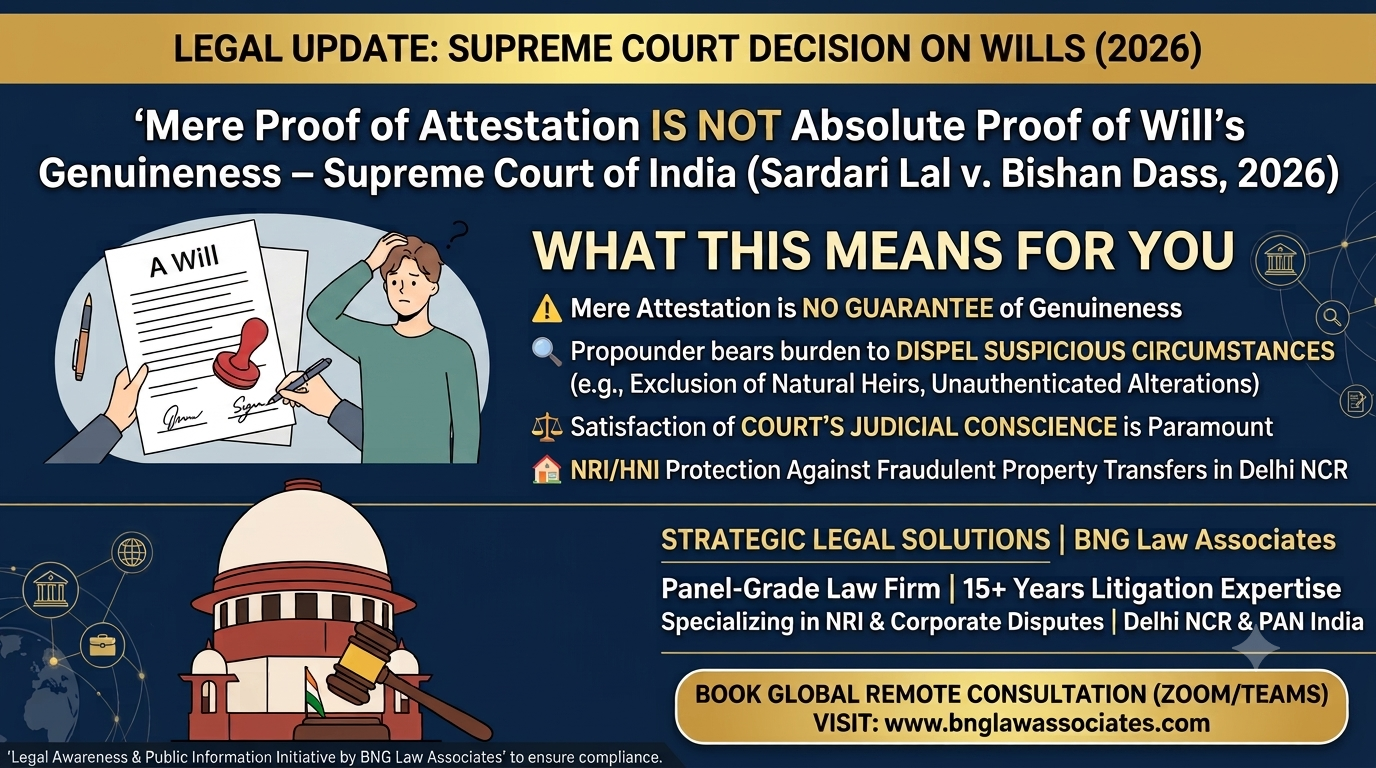
For Non-Resident Indians (NRIs) and High-Net-Worth Individuals (HNIs), safeguarding ancestral property in India from thousands of miles away remains a persistent challenge. A frequent tool used by local disputants, unauthorized occupants, or remote extended relatives to usurp valuable estates is the sudden fabrication of a "registered" Will. However, a recent landmark ruling by the Supreme Court of India fundamentally alters how these legal battles are fought, creating a massive evidentiary shield for natural legal heirs. The Precedent: Sardari Lal v. Bishan Dass (2026) In the definitive case of Sardari Lal v. Bishan Dass & Ors. [2026 LiveLaw (SC) 655], a Bench comprising Justice Manoj Misra and Justice K.V. Viswanathan dealt with a property dispute initiated by a widow claiming ownership of her late husband’s property as his sole Class I legal heir. The defendants countered by presenting a registered Will from 1974 that bequeathed the entire estate to them, claiming they had looked after the deceased. While the High Court initially held that the execution stood automatically proved because an attesting witness was examined and the document was registered, the Supreme Court completely rejected this narrow view. The Apex Court restored the trial court's decision, clarifying an essential element of property law: the mere proof of attestation under Section 63 of the Indian Succession Act is not absolute proof of a Will’s genuineness. Understanding the "Suspicious Circumstances" Shift The core of the Supreme Court's ruling rests on "judicial conscience." The Court observed that proving a Will is not a mechanical, procedural exercise to merely verify signatures. Rather, it must satisfy the court that the testator signed the document with a free mind, fully understanding its contents and effects. Where "suspicious circumstances" surround the execution of the Will, the propounder (the beneficiary relying on the Will) bears a heavy, additional burden to actively dispel those doubts. The Court highlighted several key red flags that immediately qualify as suspicious circumstances: Unjust Exclusion of Natural Heirs: Completely excluding close dependents, a spouse, or children without a robust, logical explanation integrated within the text of the Will. Unauthenticated Alterations: Changes, corrections, or names struck off on the registered document that do not bear the initials or authentication of the Sub-Registrar. Misrepresented Relationships: Describing beneficiaries as close relatives (e.g., nephews) when no evidence supports such a connection. Testator's Vulnerability: A shaky signature, an illiterate testator, or a feeble/uncertain state of mind at the time of execution. Active Beneficiary Participation: The person who benefits most taking a leading or active role in orchestrating the drafting and execution of the Will. Key Takeaway for Property Owners: A registered Will is no longer an unassailable document. If the circumstances under which it was created provoke legitimate judicial doubt, the court will discard it unless the beneficiary can prove absolute free will and informed intent. Strategic Safeguards for NRIs and HNIs This ruling significantly empowers NRI families who often find themselves on the defensive when fraudulent Wills suddenly surface locally. To protect your Indian estate against fabricated claims, consider implementing these legal frameworks: Aggressively Challenge Sudden Property Mutations: If a remote relative or occupant claims mutation of property based on a newly discovered Will, you can legally challenge it under the Sardari Lal precedent. The legal burden is on them to explain why you, as a natural heir, were excluded. Ensure Unassailable Estate Planning for Your Assets: If you are executing your own Will in India, make sure it is completely clean. Explicitly state the exact reasons if any natural heir is being left out, ensure all alterations are initialed by the Sub-Registrar, and obtain contemporaneous medical certificates of mental fitness to neutralize future claims of a "feeble mind." Conclusion: Securing Institutional Litigative Trust The Supreme Court has made it clear that the law will protect legitimate inheritance over procedural technicalities. For seamless cross-border property protection, relying on deep legal expertise is non-negotiable. Compliance & Institutional Disclaimer: This article is published as part of a Legal Awareness & Public Information Initiative. In compliance with Rule 36 of the Bar Council of India Rules, this content does not constitute advertising, solicitation, or legal advice. BNG Law Associates provides institutional-grade property litigation and estate planning for global clients. Tech-enabled remote consultations are available via Zoom and Microsoft Teams.