

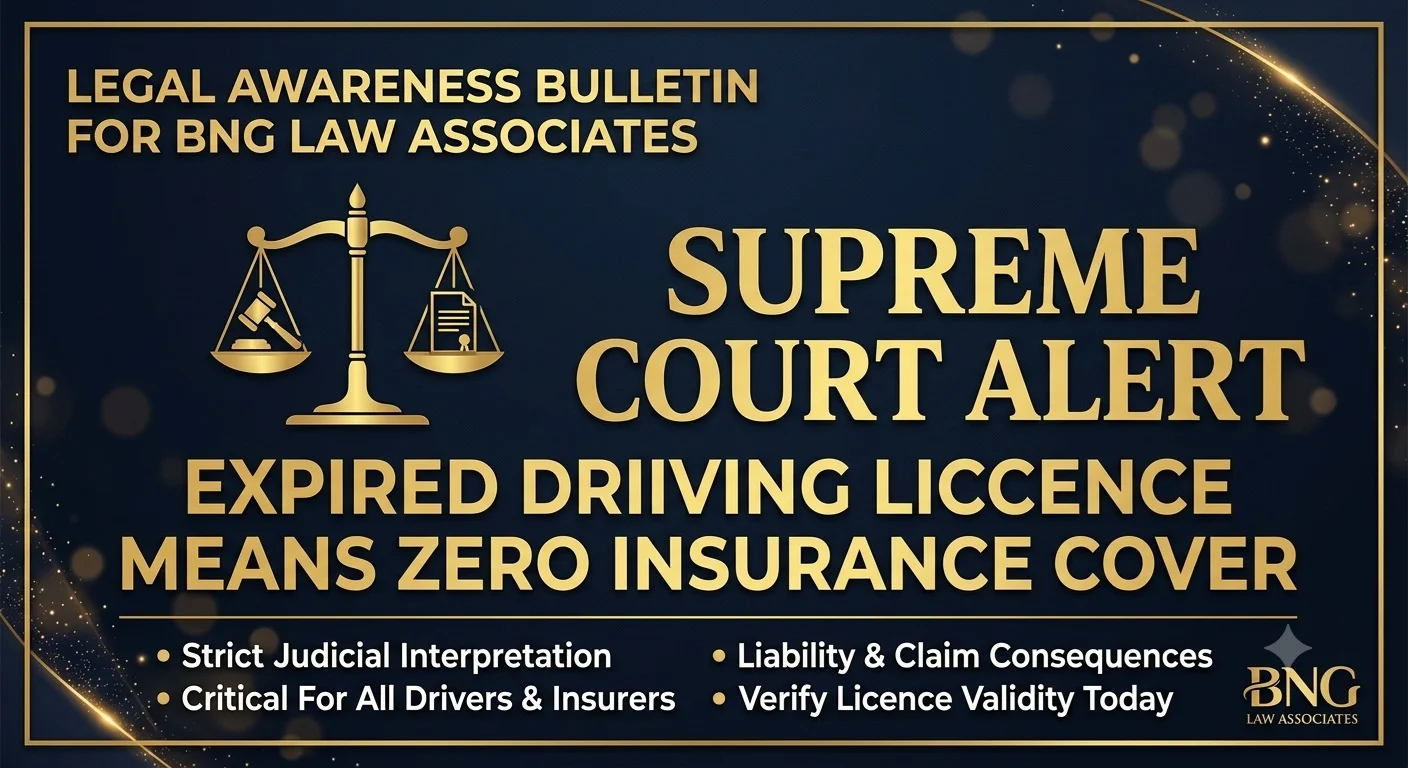
Supreme Court 2026 on Expired Driving Licences: Insurer Liability and Vehicle Owner Responsibility
A driving licence isn't just a document that lets someone get behind the wheel. Its validity can end up deciding who bears the financial burden after an accident — and whether an insurer can ultimately be held liable.
In Reliance General Insurance Company Ltd. v. Om Parkash & Ors., decided on 30 July 2026 and reported as 2026 INSC 767, the Supreme Court examined whether an insurer could be held liable for compensation where the driver did not have a valid licence at the time of the accident. The Court went through the driver's licence history, the evidence produced to establish its validity, and the responsibility of the vehicle owner to ensure the person driving was properly licensed.
For vehicle owners, employers, and fleet operators, the ruling underscores something that's easy to overlook until it becomes a serious problem: whether a driving licence was valid on the specific date of an accident can materially affect an insurance dispute. That said, the judgment shouldn't be reduced to a rule that an expired licence automatically means an insurer never pays — the facts, the evidence on record, the policy terms, and the law as applied to those specifics all still matter.
What the Supreme Court Actually Decided
The accident took place on 14 October 2009, when the insured vehicle struck a two-wheeler. Rash and negligent driving wasn't in dispute — the issue that mattered for the insurer's liability was whether the driver held a valid licence at the time.
The driver had been issued a licence back in 1992, and that much was never contested. The real question was narrower: had it been renewed, and was it valid, on the date of the accident?
The case had already travelled through two levels of adjudication with conflicting outcomes. The Motor Accidents Claims Tribunal had held the driver and owner liable and declined to fasten liability on the insurer, on the basis that the driver lacked a valid licence. The High Court took the opposite view, finding the licence valid and making the insurer liable instead. The Supreme Court went back through the evidence and disagreed with the High Court's conclusion — finding that the material on record didn't satisfactorily establish the licence was valid during the relevant period.
That reversal is worth sitting with. It shows this wasn't a straightforward case decided the same way at every stage — it turned specifically on how the evidence of renewal was assessed, and the Supreme Court read that evidence differently than the High Court had. The takeaway that survives all three levels: a person having held a licence at some earlier point doesn't, by itself, establish that the licence was valid on the date of the accident.
Why an Expired Licence Matters to an Insurer
The Motor Vehicles Act, 1988 requires anyone driving in a public place to hold an effective licence authorising them to drive that class of vehicle. Section 5 goes further, placing a direct responsibility on the owner or person in charge not to permit someone who doesn't meet the licensing requirement to drive the vehicle at all.
When an accident happens, an insurer will often check whether that requirement was actually met — and if it wasn't, the insurer may raise the relevant statutory and policy defences to dispute its liability.
There's an important distinction buried in that, though, and it's one that gets lost in casual discussion of these cases. Whether the insurer has to pay the third-party victim first is a separate question from whether the insurer can later recover that amount from the owner or driver. That distinction is where "pay and recover" comes in.
Proof of Validity: Why "He Had a Licence" Isn't Enough
One of the most instructive parts of the Om Parkash judgment is how much weight the Court placed on the actual evidence of licence validity, not just its existence.
The driver's 1992 licence wasn't enough on its own — what had to be established was whether it remained valid during the relevant period. The Court went through the licensing records and the material relied on to prove renewal, and found it insufficient. This is precisely the point on which the Supreme Court parted ways with the High Court's earlier finding.
The lesson generalises well beyond this case: the relevant question isn't whether a driver ever held a licence, but whether it was valid and effective on the date that matters, and whether it covered the right class of vehicle. Owners and fleet operators should be keeping records that can answer that cleanly — licence number, dates of issue and expiry, vehicle class authorised, renewal history, and evidence of whatever verification was actually carried out. For businesses running more than a handful of vehicles, a central verification system pays for itself the first time a claim is disputed.
Where official licensing records are available, they're what should be relied on — not recollection or incomplete paperwork. This matters most where there's a live dispute about whether a licence was renewed, when, whether there was a gap between expiry and renewal, or whether it covered the right vehicle class. The practical implication is timing: this evidence needs to be gathered and preserved early in a claim, not reconstructed months later.
What the Vehicle Owner Is Actually Responsible For
Section 5 of the Motor Vehicles Act doesn't just describe a driver's obligation — it puts a direct duty on the owner or person in charge not to let an unlicensed or improperly licensed person drive at all. The Supreme Court's reasoning in Om Parkash engaged with that responsibility directly, not just the driver's own compliance.
That means an owner can't assume a driver stays legally authorised forever just because they were licensed when first engaged. For an individual owner, that might mean checking the licence before handing the keys to someone who'll be driving regularly. For an employer or fleet operator, it needs to be systematic — manual, ad hoc checks don't scale past a handful of vehicles, and tend to fail exactly when it matters most.
"Pay and Recover," Explained
"Pay and recover" comes up constantly in motor accident litigation, and it's worth being precise about what it actually means. In appropriate cases, a court may direct the insurer to pay the compensation to the third-party victim first — so the victim isn't left waiting on a dispute between the insurer and the owner — while permitting the insurer to later recover that amount from whoever is found responsible for the breach, in line with the court's order.
In Om Parkash, the Supreme Court applied the pay-and-recover principle after finding that the evidence did not establish a valid driving licence at the relevant time and that the breach affected the insurer's liability.
It's not an automatic outcome of every case involving an expired licence, though. Whether it applies depends on the facts, the evidence, the nature of the breach, the applicable statutory provisions, the policy terms, and what the court actually directs. The statement "expired licence means the insurer will never pay" is simply too broad — the more accurate position is that licence validity and the resulting breach can affect the insurer's ultimate liability, with the court determining the actual consequences on the facts in front of it.
Where a court does find a breach and grants recovery rights, the exposure can shift substantially onto the vehicle owner. In Om Parkash, the compensation quantified by the High Court exceeded ?1 crore with interest — a useful illustration of how significant these numbers can get, and why licence verification is genuinely part of managing insurance risk rather than an administrative afterthought.
Does a Later Renewal Fix an Earlier Gap?
Not on its own. If the licence was renewed after the accident, that renewal doesn't retroactively establish it was valid during the period the accident occurred in. If there was a gap between expiry and renewal, the licensing records for that specific window are what will settle the question — particularly where an insurer is disputing the claim on exactly this basis.
Building a Verification Process That Actually Holds Up
The practical steps here look broadly similar whether you're an individual owner, a corporate fleet operator, or an NRI managing a vehicle from abroad — what changes is scale and who's doing the checking.
At the core, the process should cover: verifying the licence before handing over the vehicle (or before an employee starts driving for the company), recording the expiry date, checking the vehicle class the licence actually authorises, re-verifying periodically rather than once and forgetting, keeping copies or digital records of what was checked and when, and setting a reminder ahead of expiry so renewal doesn't slip.
For individual owners, this is a short, occasional check — worth doing before letting anyone drive the vehicle regularly, and worth having some record of having done it.
For companies and fleet operators, this needs to be a standing system rather than a one-time step. A driver compliance register — name, licence number, authorised category, expiry date, verification date, next review date, assigned vehicle, and current status — turns an unmanageable manual task into something that scales. The same standard should extend to drivers supplied through logistics vendors or transport contractors; a compliance clause in the vendor contract requiring valid licences for anyone deployed on company work, along with supporting records from the vendor, closes an otherwise easy gap.
For NRIs who own vehicles in India, the practical challenge is usually distance rather than scale — you're not there to check the paperwork yourself. Appointing a responsible local person to manage the vehicle, keeping digital copies of documents, and setting renewal reminders addresses most of that gap. If an accident does result in a compensation award and the insurer secures recovery rights, the consequences — including any execution proceedings — will depend on the award, the court's directions, and the applicable procedural law, so it's worth having someone who can act on your behalf in India if that situation arises.
Key Takeaways
- A previously issued licence doesn't prove it was valid on the date of the accident — that has to be established for the relevant period specifically, as the Tribunal-to-Supreme-Court reversal in this case shows.
- Section 5 of the Motor Vehicles Act puts a direct duty on the owner, not just the driver, to ensure the person driving is properly licensed.
- Official licensing records can be particularly important when validity is disputed, especially where the renewal history or a gap in validity has to be established.
- A later renewal doesn't retroactively cover an earlier disputed period.
- "Pay and recover" separates two distinct questions — who gets paid first, and who ultimately bears the cost — and doesn't apply automatically just because a licence had expired.
- The financial stakes can be substantial: the compensation in this case exceeded ?1 crore with interest.
- The actual insurance outcome always depends on the specific facts, evidence, policy terms, and what the court finds.
Frequently Asked Questions
Does an expired driving licence automatically defeat an insurance claim?
No — but it can give the insurer grounds to dispute liability. Whether that dispute succeeds depends on the specific facts and evidence, not on the mere fact that the licence had lapsed.
What exactly did the Supreme Court decide in the 2026 Om Parkash case?
That the evidence didn't establish the driver's licence was valid on the date of the accident, reversing the High Court's contrary finding — and that the insurer's position should be accepted on those facts, with the consequences worked out through the pay-and-recover framework.
Can an insurer actually recover money already paid to a victim from the vehicle owner?
Yes, where a court finds a relevant breach and specifically grants recovery rights — but this isn't automatic, and depends entirely on what the court's order actually says.
If the licence gets renewed after the accident, does that cover the earlier period?
No. The relevant question is always validity on the date of the accident itself, not whether it was eventually renewed afterward.
What responsibility does Section 5 of the Motor Vehicles Act place on a vehicle owner?
It prohibits an owner or person in charge from permitting someone who doesn't meet the licensing requirements to drive the vehicle — making licence verification the owner's obligation, not just the driver's.
What's the single most useful thing a fleet operator can do to reduce this risk? Mo
ve from one-off checks to a standing verification system — a compliance register with expiry tracking and periodic re-verification catches problems before they become an accident, not after.
What evidence is needed to prove that a driving licence was valid on the date of an accident?
The relevant licensing authority's records and other legally admissible evidence may be important, particularly where the renewal history or validity of the licence is disputed. The evidence required will depend on the facts and the issue the parties need to establish.
The Bottom Line
Om Parkash is a reminder that driving licence validity has consequences that reach well past whether someone is legally allowed to drive that day — and the case's own path through three levels of courts, each reaching a different conclusion on the same evidence, shows how much can turn on how that evidence is read. For owners, the lesson is straightforward: a driver who's held a licence for years isn't automatically authorised to drive today — that has to be checked, not assumed. For businesses and fleet operators, it's a case for building a real verification system rather than relying on informal trust. And for anyone in the middle of a motor accident claim, understanding the distinction between licence validity, insurer liability, third-party compensation, and pay-and-recover rights can genuinely change how the case is argued.
The exact legal position will always turn on the specific facts and evidence in front of the court. Anyone dealing with an insurer's denial, a recovery notice, or a disputed motor accident claim should have their documents reviewed by a qualified legal professional rather than relying on a general summary of the law.
Primary Legal Source
Reliance General Insurance Company Ltd. v. Om Parkash & Ors., 2026 INSC 767, Supreme Court of India, judgment dated 30 July 2026.
.jpeg)

Comments (0)
Abhi tak koi comment nahi hai. Sabse pehle comment karein!
Apna Comment aur Rating dein