

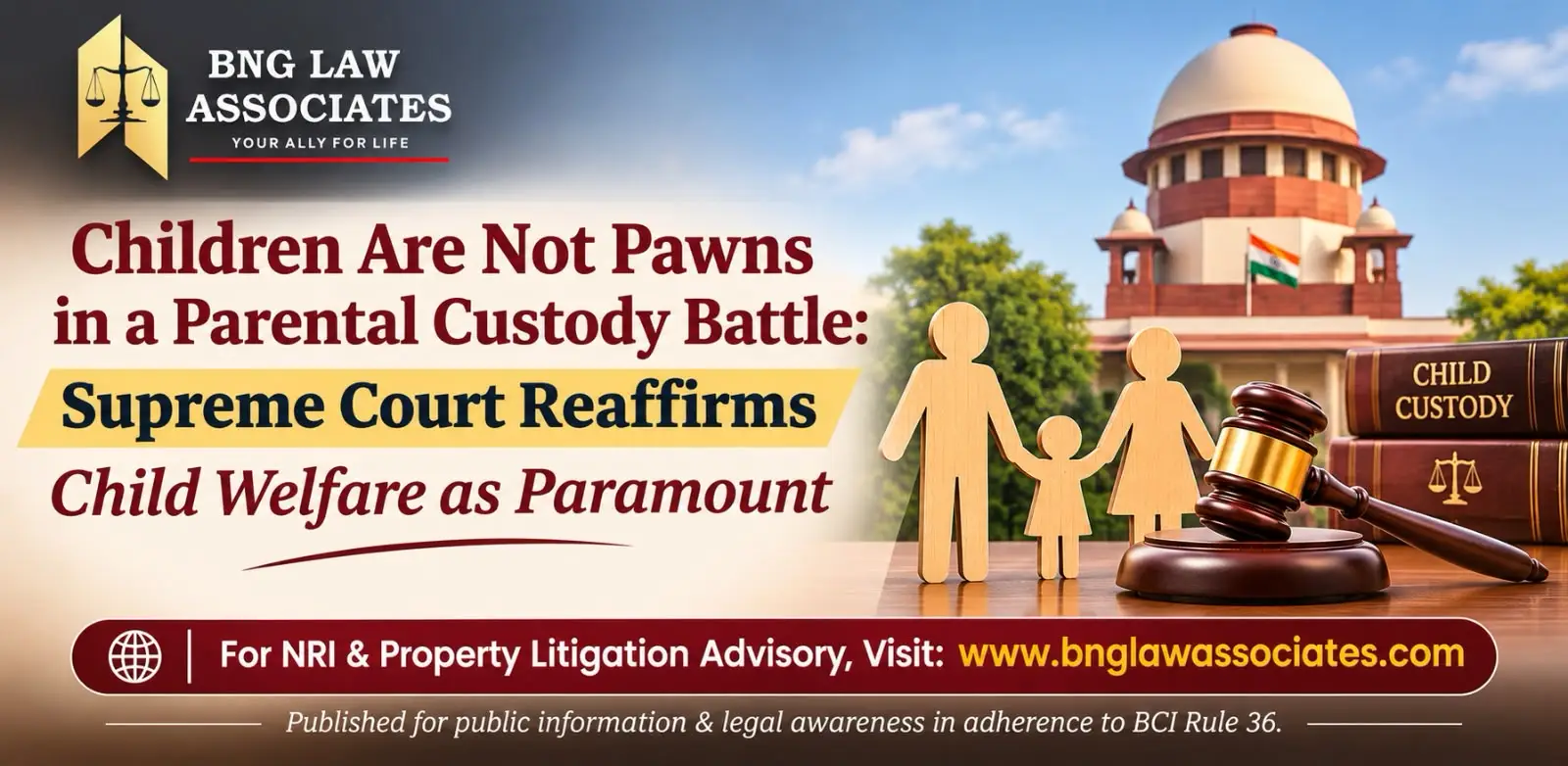
Children Are Not Pawns in a Custody Battle: Supreme Court Reaffirms That Child Welfare Is Paramount
The Supreme Court allows two minor sons to remain with their mother, citing emotional stability, continuity of care and the children's considered preference, while protecting their relationship with their father.
Introduction
The Supreme Court has once again made it clear that in a custody battle, the child's welfare comes first and the parents' competing legal claims come second. In J. Sakthi Devi @ Chriti v. Joseph Charles (2026 INSC 1260), it set aside the Family Court and Madras High Court orders that had granted custody of two minor sons to their father and allowed the boys to remain with their mother.
The father was a natural guardian, and no finding had been made that he was unfit. Even so, the Court held that moving the boys from the home in which they had grown up would not serve their best interests. It also made specific arrangements to ensure that their father remained meaningfully involved in their lives.
Background of the dispute
The parties, a Christian couple, married on 23 August 2009 at Coimbatore and separated in 2014. They have two sons, born in 2010 and 2012.
On 19 November 2018, the Family Court at Madurai granted the husband a divorce on the ground of cruelty, which the wife did not challenge. On the same day, it directed him to pay ?6,000 per month for each child as maintenance. However, in separate proceedings under the Guardians and Wards Act, 1890, it granted him custody of the children and directed the mother to hand them over after their final school examinations that year.
The mother challenged the custody order before the Madras High Court. While admitting her appeal, the High Court directed the parties to maintain status quo and preserved the father's visitation rights at the Gandhi Museum in Madurai. It eventually upheld the custody order, finding no material to support the mother's allegations about the father's mental condition and observing that she had not allowed him to meet the children despite earlier court directions.
The mother then approached the Supreme Court, which stayed the High Court's judgment on 24 January 2025. The boys continued living with her while the appeal was pending. The father subsequently sought to vacate the stay, alleging that his visitation rights were being denied.
What the boys told the Court
The Court directed both parents and the two boys, then aged 16 and 14, to appear before it. It spoke to the children in the absence of their parents to understand their views.
They told the Court that they had met their father only four or five times and had lived with him for approximately two years during their early childhood. They also confirmed that they lived with their mother and maternal grandparents and clearly expressed their wish to continue living with their mother.
The Bench found the boys mature enough to understand their circumstances and communicate their preferences. Their wishes therefore became an important factor in deciding where their welfare would best be served.
Welfare is the paramount consideration
Justice Vikram Nath and Justice Aparesh Kumar Singh reiterated that, under Section 17 of the Guardians and Wards Act, 1890, the welfare of the minor is the paramount consideration in guardianship and custody proceedings.
The Court must consider relevant circumstances, including the child's age, sex and religion, as well as the character and capacity of the proposed guardian. Section 17(3) further allows the Court to consider the preference of a minor who is old enough to form an intelligent opinion.
The Court also clarified the position concerning natural guardianship under amended Section 19(b), recognising both the father and mother as natural guardians. A parent's status as a natural guardian does not automatically establish an entitlement to physical custody. The principle favouring custody with the father is not an inflexible rule and must always yield to the child's welfare.
The Act also concerns the child's health, maintenance, education and overall protection. Custody disputes, therefore, cannot be decided through a narrow assessment of parental rights alone. As the Court reiterated, "Children are not mere chattels, nor are they toys for their parents."
Why stability and emotional bonds prevailed
The boys had lived continuously with their mother since 5 May 2014. The Court found that she had taken sole responsibility for their upbringing and education. They studied in good schools and had developed strong emotional bonds with her and their maternal grandparents.
The Court did not overlook the father's position. It acknowledged that he had sufficient financial resources, was willing to support the children's upbringing and higher education, and had a genuine grievance about his limited opportunities to meet his sons. Despite favourable custody orders from the Family Court and High Court, he had met them only four or five times in approximately 10 to 12 years.
However, the decisive question was not simply whether the father could provide for the children or was legally entitled to seek custody. It was whether transferring them to him at that stage would promote their welfare.
The Court concluded that removing the boys from their familiar home and surroundings could disturb their emotional stability and adversely affect their mental and physical well-being and education.
Importantly, this conclusion was reached even though no ground had been established to disqualify the father from acting as a guardian. The judgment highlights an important distinction: a parent's fitness to be a guardian is one question, while whether changing the child's physical custody would serve the child's welfare is another.
It also makes clear that financial capacity alone cannot determine custody. A parent's ability to provide financial support must be considered alongside the child's emotional security, continuity of care, education and overall well-being.
Keeping the father in the picture
The Court stressed that the boys should not be deprived of their father's love and affection. It recognised the importance of maintaining meaningful relationships with both parents for the children's balanced development.
Accordingly, it issued the following directions:
- Regular visitation: The father may meet the children on the second Saturday and Sunday of every month, from 10:00 a.m. to 2:00 p.m., at the Gandhi Museum in Madurai. The mother must facilitate these meetings.
- Festival and vacation visits: He may also meet the children during Pongal and half-yearly vacations, either at the mother's residence or at the Gandhi Museum, during the same hours.
- Prior intimation: For these vacation visits, the father must inform the mother in advance by telephone or WhatsApp.
- Educational expenses: The father must remain ready and willing to share the children's future educational expenses if requested by the mother.
These arrangements aim to help the boys maintain an emotional attachment with their father and ensure that custody with one parent does not result in the exclusion of the other from the children's lives.
Key takeaways for custody cases
The judgment reinforces several important principles of Indian child custody law:
- Welfare comes first: The child's best interests take priority over competing parental claims.
- Natural guardianship does not guarantee physical custody: A parent's status as a natural guardian does not automatically entitle them to physical custody.
- A mature child's preference matters: Under Section 17(3), courts may consider the views of a child mature enough to form an intelligent opinion.
- Continuity and emotional stability matter: An established home, emotional bonds, schooling and continuity of care are important factors in assessing welfare.
- Financial capacity is not decisive: A parent's ability to provide financial support does not, by itself, determine which custody arrangement best serves the child.
- Both parental relationships deserve protection: Courts can establish visitation arrangements to preserve the child's relationship with the non-custodial parent.
The Court also relied on principles discussed in earlier decisions, including Anjali Kapoor v. Rajiv Bajaj (2009) 7 SCC 322 and Rosy Jacob v. Jacob A. Chakramakkal, which emphasise that custody decisions must be guided by the child's welfare rather than a mechanical application of parental rights.
Conclusion
Custody is not a prize for the parent with the stronger legal claim or greater financial resources. By allowing the two boys to remain in the home in which they had grown up while securing regular opportunities to meet their father, the Supreme Court balanced continuity of care with the importance of maintaining relationships with both parents.
The judgment sends a clear message: in a custody dispute, the question is not which parent should win, but what arrangement will best serve the child.
Case details
|
Particular |
Details |
|
Case title |
J. Sakthi Devi @ Chriti v. Joseph Charles |
|
Court |
Supreme Court of India |
|
Neutral citation |
2026 INSC 1260 |
|
Case number |
Civil Appeal arising out of SLP (Civil) No. 30284 of 2024 |
|
Bench |
Justice Vikram Nath and Justice Aparesh Kumar Singh |
|
Date of judgment |
23 November 2026 |
|
Legislation |
Guardians and Wards Act, 1890 |
|
Provisions discussed |
Sections 17, 17(3) and 19(b) |
|
Courts below |
Family Court, Madurai and Madras High Court |
Source: Supreme Court of India – Official Judgment (2026 INSC 1260)
Disclaimer
This article is prepared for general legal information and public awareness based on the Supreme Court's judgment in J. Sakthi Devi @ Chriti v. Joseph Charles. It is not legal advice and should not be treated as a substitute for reading the complete judgment or seeking advice on an individual matter. The outcome of a custody dispute depends on its specific facts and the welfare of the child concerned.

.jpeg)

Comments (0)
Abhi tak koi comment nahi hai. Sabse pehle comment karein!
Apna Comment aur Rating dein