

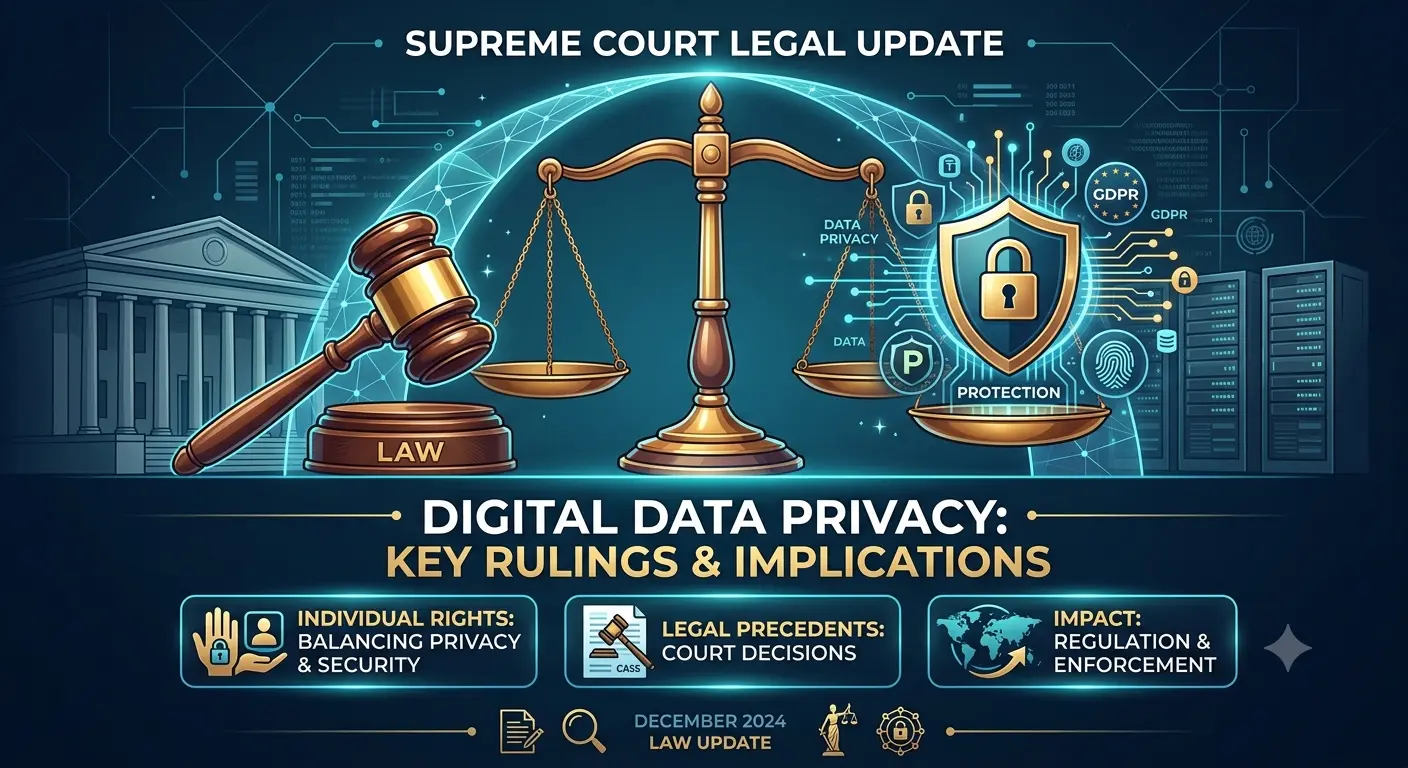
Supreme Court Just Tightened the Rules on APAAR and DPDP Act Compliance - Here's What Changed
Abhishek Baxi v. Union of India (2026): Parental Consent, Student Data, and the DPDP Act
The Supreme Court has weighed in on one of the more contentious issues surrounding the Automated Permanent Academic Account Registry (APAAR) — whether parents actually had a real choice to say no. In Abhishek Baxi v. Union of India, W.P.(C) No. 832/2026 (2026 LiveLaw (SC) 719), a bench of Chief Justice Surya Kant, Justice Joymalya Bagchi and Justice V. Mohana directed the Union Government and CBSE to fix the model APAAR consent form so that parents and guardians are given an express option to withhold or refuse consent.
|
Case |
Abhishek Baxi v. Union of India |
|
Number |
W.P.(C) No. 832/2026 |
|
Court |
Supreme Court of India |
|
Citation |
2026 LiveLaw (SC) 719 |
|
Bench |
CJI Surya Kant, Justice Joymalya Bagchi, Justice V. Mohana |
|
Core issue |
Parental consent, student data privacy, third-party disclosure under APAAR |
|
Headline direction |
Pan-India opt-out mechanism in the APAAR consent process |
What APAAR Actually Is
APAAR is the government's attempt at giving every student a permanent digital academic identity - one record that follows them through school and beyond, making it easier to track and manage academic history. Sensible enough in theory. The problem is that it necessarily means collecting personal data about children, and consent frameworks involving minors tend to invite more scrutiny than most.
That's exactly what happened here. The petition questioned whether parents were genuinely free to opt out, and what happened to their children's data once it was collected. Both questions forced the Court to look closely at the consent form itself.
The Core Problem: Consent Without a Real "No"
The issue traces back to the Orissa High Court's ruling in Rohit Anand Das v. State of Odisha, where the Court — in paragraph 19 — flagged that the model consent form didn't clearly let parents refuse. You could go through the process, but there was no obvious button, box, or line to say "we don't want to participate."
That's a meaningful gap. A consent form that technically exists but doesn't present refusal as a real option isn't really consent — it's a formality. The Supreme Court agreed, and rather than leaving the fix to Odisha alone, extended the safeguard nationwide, directing every authority implementing APAAR to build in an actual refusal mechanism.
Why This Matters More Than It Sounds
For parents, this is fairly simple: the form has to make clear that saying no is a legitimate, exercisable choice — not buried, not implied, not something you have to infer.
For the authorities running APAAR, it means the current consent workflow needs an honest review, not a cosmetic tweak. And to be clear — the Court didn't touch the legality of APAAR itself. This isn't a ruling that shuts the scheme down. It's a ruling about how consent has to work within it.
The DPDP Angle: Data Handling Gets Scrutinized Too
The second major thread in the judgment concerns what happens to the data after it's collected. The Court made clear that any personal information gathered under APAAR has to be handled in line with the Digital Personal Data Protection Act, 2023 — which, notably, has specific provisions for how children's data is treated.
That's not a throwaway line. Student records inherently involve minors, and the DPDP Act treats that category differently from adult data. Schools and any technology vendors touching this data now have a clearer legal backdrop against which their practices will be measured.
DPDP Act Compliance
Where Institutions Should Be Looking
If you're an educational institution or vendor in this space, it's worth actually sitting down and reviewing:
- Why you're collecting student data in the first place, and whether that purpose is still accurate
- What parents are actually told at the point of collection
- How consent is documented (not just obtained — documented)
- Who inside the organization can access student records
- What data-sharing agreements exist with outside vendors
- How long data is retained, and whether it's deleted when it should be
- The specific contract language governing third-party processing
- What happens when something goes wrong — is there an actual incident response process
None of this is a checklist mandated line-by-line by the judgment. It's the natural set of questions the ruling raises.
No Free Passing of Data to Third Parties
The other significant piece: the Court was explicit that personal information collected under APAAR can't be handed off to private entities or third parties except where the law permits it, and only for purposes the law actually authorizes. Sharing data outside the scope of the scheme, or for some unrelated purpose, isn't allowed.
This matters because student data has a way of ending up in more hands than intended — ed-tech platforms, analytics vendors, third-party integrations. The ruling pushes institutions to actually be able to answer: what's being collected, why, who has access, who it's shared with, under what legal basis, for what purpose, and for how long. If an institution can't answer those questions cleanly, that's the gap to close first.
Practical Steps for Institutions
A few areas worth prioritizing:
- Consent forms — confirm the refusal option is explicit, not implied
- Data mapping — know where student data lives, who touches it, and where it goes
- Vendor contracts — check that third-party agreements actually address data protection obligations, not just service terms
- Access controls — restrict data access to people who genuinely need it
- Retention policy — get rid of data you no longer have a legal reason to keep
- DPDP readiness — figure out which provisions of the Act and Rules actually apply to you right now
One Catch: The DPDP Act Doesn't Switch On All at Once
Worth flagging separately — the DPDP Act, 2023 doesn't have a single commencement date. Certain provisions took effect on 13 November 2025, while others are staggered to come into force one year or eighteen months later. The DPDP Rules, 2025 follow a similarly phased rollout.
So compliance planning has to account for which provisions are actually live at a given point in time — not just assume the entire Act is operative because parts of it are.
The Bigger Picture
This case sits within India's broader Article 21 privacy jurisprudence, where informational privacy has been recognized as a constitutional right. Digitizing academic records doesn't exempt the process from that framework — if anything, it raises the stakes, because the subjects here are children who can't meaningfully consent on their own behalf.
What This Ruling Does — and Doesn't — Do
It does:
- Require an actual opt-out/refusal option in the APAAR consent form, nationwide
- Restrict disclosure of APAAR data to private parties or third parties outside legal authorization
- Push institutions to take DPDP compliance seriously where student data is involved
It doesn't:
- Strike down APAAR
- Ban all processing of student data
- Prohibit every third-party disclosure regardless of legal basis
- Require every school to overhaul unrelated admission forms
- Prescribe specific technical measures like encryption standards or access-control architecture
This article is for general informational purposes and isn't legal advice. How the judgment and the DPDP Act apply will depend on your specific facts, role, and which provisions are in force at the relevant time. Get case-specific advice before making compliance or litigation decisions.

.jpeg)

Comments (0)
Abhi tak koi comment nahi hai. Sabse pehle comment karein!
Apna Comment aur Rating dein