

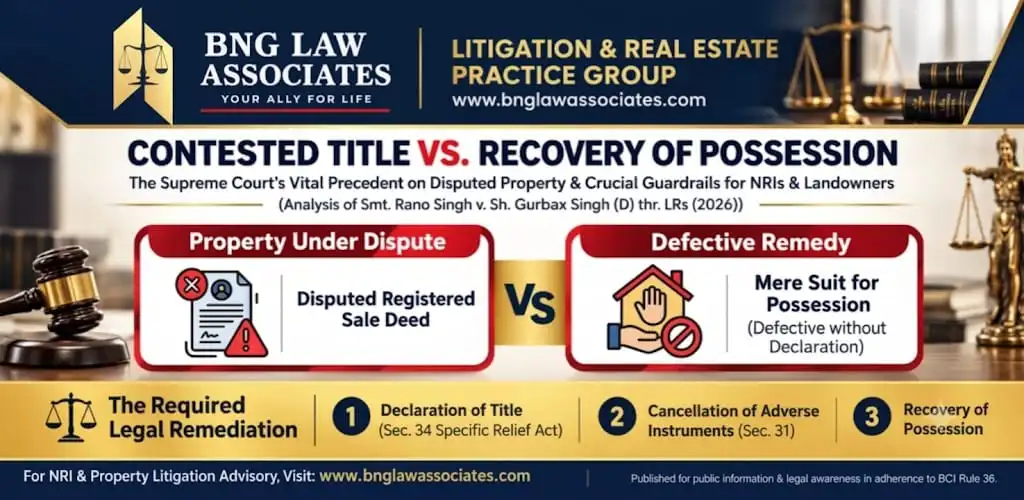
Suit for Possession When Property Title Is Disputed: Supreme Court Ruling in Rano Singh v. Gurbax Singh (2026)
On 16 October 2026, the Supreme Court held that a bare suit for possession cannot succeed where a registered sale deed in the defendant’s favour clouds the plaintiff’s title. The heirs of an original agreement-to-sell holder needed to seek cancellation of that deed, or specific performance of the agreement, and to do so within limitation. They did neither in time, and their suit, filed in 1975, was held “hopelessly barred.”
Can You Claim Possession When Someone Else Holds a Registered Sale Deed?
Suppose you believe a property rightfully belongs to you, but the person occupying it relies on a registered sale deed. Can you simply ask the court for possession, or must you first challenge the document the other side relies on?
In Smt. Rano Singh and Others v. Sh. Gurbax Singh (D) through LRs and Others (2026 INSC 1137), a bench of Justice Aravind Kumar and Justice Vipul M. Pancholi answered that question in a dispute that began in 1952. The ruling matters to property owners, legal heirs, investors and Non-Resident Indians (NRIs) who manage Indian property from abroad and often learn of competing claims late.
The lesson is not that every possession suit must ask for every possible relief. It is that a claimant must identify the real legal obstacle to the claim, and seek the remedies that remove it, before limitation runs out.
Rano Singh v. Gurbax Singh: Case at a Glance
|
Particular |
Details |
|
Case name |
Smt. Rano Singh and Others v. Sh. Gurbax Singh (D) through LRs and Others |
|
Court |
Supreme Court of India |
|
Citation |
2026 INSC 1137; 2026 LiveLaw (SC) 1081 |
|
Case number |
Civil Appeal No. 7025 of 2012 |
|
Decided on |
16 October 2026 |
|
Bench |
Justice Aravind Kumar and Justice Vipul M. Pancholi |
|
Main issues |
Maintainability of a possession suit, competing title, limitation, estoppel, part-performance |
|
Outcome |
Appeal dismissed; dismissal of the possession suit upheld |
You can read the full judgment on Indian Kanoon.
What Happened in Rano Singh v. Gurbax Singh?
The dispute spans more than seven decades:
- 1952: A society agreed to sell a plot to Sohan Singh, on the condition that he construct on it within a fixed period.
- 1954: Sohan Singh wrote to the society that he could not build and asked that the plot be transferred to Gurbax Singh.
- Thereafter: Gurbax Singh built a house and remained in possession.
- December 1960: The society executed a registered sale deed in favour of Gurbax Singh.
- 1975: Sohan Singh’s legal heirs sued for possession on the strength of the 1952 agreement. They did not seek cancellation of the 1960 sale deed or specific performance of the agreement.
The Trial Court held the suit maintainable and within limitation, but dismissed it on the ground of estoppel. The Delhi High Court affirmed the dismissal, holding the suit barred by limitation and rejecting the plea of part-performance under Section 53A of the Transfer of Property Act, 1882.
The Supreme Court dismissed the further appeal. It reached the same result on firmer ground: the suit was barred by limitation, an agreement to sell without a registered sale deed conferred no title, part-performance was unavailable, and Sohan Singh’s own conduct estopped his heirs.
Why a Suit for Possession Alone Failed
The Court relied on the framework in Anathula Sudhakar v. P. Buchi Reddy, (2008) 4 SCC 594:
- Plaintiff in possession, no genuine cloud on title: a suit for injunction is generally appropriate.
- Plaintiff out of possession, title not seriously disputed: a suit for possession based on title may be maintained.
- Plaintiff’s title under a genuine cloud: the plaintiff must also seek a declaration of title, with any consequential relief.
In Rano Singh, the 1960 registered sale deed was exactly such a cloud. The Supreme Court said it could not accept the Trial Court’s view that a bare possession suit was maintainable. Two points follow.
- An agreement to sell does not confer ownership. Under Section 54 of the Transfer of Property Act, a contract for sale does not by itself create an interest in the property. It gives contractual rights, which can be enforced through a suit for specific performance within limitation.
- The registered deed had to be confronted. The heirs needed to seek cancellation of the 1960 deed or specific performance of the 1952 agreement. Asking for possession alone left the deed standing, and with it the defendant’s title.
Sections 31 and 34 of the Specific Relief Act, 1963
Two provisions are relevant when a competing instrument stands in the way:
- Section 31 (cancellation of instruments): a person who reasonably apprehends serious injury from a void or voidable written instrument left outstanding may ask the court to have it cancelled.
- Section 34 (declaratory relief): a person entitled to a legal character or a right in property may seek a declaration against anyone denying it. The proviso allows the court to refuse a declaration where the plaintiff could have sought further relief and did not.
Practical takeaway: Before filing a possession suit, read the document the other side relies on. If it blocks your claim, ask whether the suit must also seek a declaration, cancellation or specific performance.
Limitation: The Ground That Ended the Case
Even apart from maintainability, the suit was out of time. The Court held it barred under Articles 54, 59 and 64 of the Limitation Act, 1963, even if time were counted from the plaintiffs’ own date of knowledge. The judgment records that the limitation period expired in 1972, while the suit was filed in 1975. The High Court had also observed that, on the plaintiffs’ own case, the period for challenging the sale deed ended in 1966.
|
Article |
Claim |
General limitation period |
|
Article 54 |
Specific performance of a contract |
3 years from the date fixed for performance or, if none, from when the plaintiff has notice of refusal |
|
Article 59 |
Cancelling or setting aside an instrument or decree, or rescinding a contract |
3 years from when the facts entitling the plaintiff to relief first become known |
|
Article 64 |
Possession based on previous possession, not title |
12 years from the date of dispossession |
|
Article 65 |
Possession based on title |
12 years from when the defendant’s possession becomes adverse to the plaintiff |
Does every title-based possession suit have 12 years?
Not where the claim first depends on setting aside a deed or enforcing an agreement. Article 65 gives 12 years for a possession suit based on title. But if your title can only be established by cancelling an instrument or enforcing a contract, the shorter three-year periods in Articles 59 and 54 apply to that relief. They run however long the property has been in the family.
Practical takeaway: Do not count limitation from the day you discovered someone else in possession. Fix the date of the agreement, the conveyance, any refusal to perform, dispossession, and your first knowledge of the competing claim.
Section 53A of the Transfer of Property Act: Why Part-Performance Did Not Help
Section 53A protects a transferee under a written contract who has taken or continued in possession, or done some act in furtherance of the contract, and who has remained ready and willing to perform their part. It is a shield against the transferor, not a source of ownership.
The Court held that the protection was unavailable for two reasons:
- The plaintiffs were out of possession. Possession was with Gurbax Singh.
- Sohan Singh was not ready and willing to perform. Construction within the fixed period was a mandatory term of the 1952 agreement. By telling the society he could not build, he abandoned it, and Section 53A cannot cure abandoned obligations.
Estoppel: Why the Original Allottee’s Letter Mattered
The Court also relied on Sohan Singh’s 1954 letter asking the society to transfer the plot to Gurbax Singh. Under Section 115 of the Indian Evidence Act, 1872, a person who by words or conduct has led another to act on a belief cannot later deny it. Gurbax Singh built a house and lived on the plot for years after that letter. The Court held that Sohan Singh, and those claiming through him, were estopped from asserting the plot as their own.
This does not mean every letter or period of silence defeats a property claim. It does mean that what you write, and how you behave toward the property, can be used against your heirs.
What Property Owners Should Learn from Rano Singh
In our experience, property suits more often go wrong because the pleading and the timing do not match the real dispute than because the claimant has no right. Four practical lessons follow.
- Examine the competing documents first. If another person holds a registered deed that conflicts with your claim, obtain it and read it before choosing your remedy.
- Match the remedy to the dispute. Possession, declaration, cancellation and specific performance are different remedies with different limitation periods.
- Check limitation at the outset. Build a chronology of the agreement, performance, communications, competing documents and possession.
- Review the agreement’s own conditions. Obligations on payment, construction or approvals can decide whether an old agreement still gives you any rights.
What NRIs Managing Property in India Should Know
Rano Singh was not an NRI case, but its lessons apply with extra force to owners abroad. Distance tends to cause delay, and delay is exactly what limitation law penalises. A tenant who stops paying rent, a neighbour who builds on the plot, or a relative who sells under an old power of attorney can create a competing claim that you hear about years later.
If you learn that someone else claims your property:
- Collect the paper trail. Gather sale deeds, agreements to sell, allotment letters, inheritance documents, powers of attorney, correspondence and earlier notices.
- Obtain the competing instrument. Get a certified copy and check who executed it, with what authority, and how the property is described.
- Check the records. Review encumbrance certificates, registration records, mutation entries, tax receipts and earlier court orders. Mutation entries alone do not prove ownership.
- Fix the dates. Note when the agreement was made, when the competing document was executed, when you learned of it, when possession changed and when performance was refused.
- Take advice and arrange representation. NRIs can generally act through an advocate and, where appropriate, an authorised representative under a valid power of attorney. Authentication and personal-appearance requirements vary by proceeding, so confirm them with your advocate.
Documents to Review Before Filing a Property Suit
|
Document or record |
Why it matters |
|
Sale deed or conveyance deed |
Shows the documentary basis of a claimed transfer |
|
Allotment letter |
Shows the terms on which the property was allotted |
|
Agreement to sell |
Shows contractual rights, conditions and performance obligations |
|
Earlier title documents |
Traces the chain of ownership |
|
Encumbrance certificate and registration records |
Reveals registered transactions affecting the property |
|
Mutation and revenue records |
Shows recorded changes, though not conclusive proof of title |
|
Proof of possession |
Shows who occupied the property and since when |
|
Letters, notices and correspondence |
Shows knowledge, representations, objections or refusal to perform |
|
Power of attorney |
Shows the scope of a representative’s authority |
|
Payment and construction records |
Shows performance of contractual obligations |
|
Earlier pleadings, judgments and orders |
Shows issues already decided and relevant dates |
Frequently Asked Questions
Can I file a suit for possession if someone else claims ownership of my property?
Yes, where you can establish a legal basis for recovering it. But if the defendant relies on a registered sale deed that creates a genuine competing claim to title, a bare possession suit may fail, as it did in Rano Singh. You may also need a declaration, cancellation of the deed, or specific performance.
Can I sue for possession without seeking a declaration of title?
Sometimes. A declaration is not required in every possession suit. Where your title is genuinely disputed, or a competing instrument must be addressed for your claim to succeed, the court will expect declaratory or consequential relief as well.
Does a registered sale deed automatically prove ownership?
No, but it is strong evidence and cannot be ignored. Its effect depends on whether the executant had the right and authority to sell, whether the transaction was valid, and whether a recognised ground exists to challenge it. A deed not challenged in time generally stands.
What is the limitation period for cancelling a sale deed in India?
Under Article 59 of the Limitation Act, 1963, generally three years from when the facts entitling you to seek cancellation first become known to you.
What is the limitation period for specific performance of an agreement to sell?
Under Article 54, generally three years from the date fixed for performance or, if none is fixed, from when you have notice that performance is refused.
Is an agreement to sell enough to establish ownership?
No. An agreement to sell does not by itself transfer ownership of immovable property. Title passes through a registered conveyance. An agreement can, however, support a suit for specific performance if brought within time.
Does Section 53A protect someone who holds only an agreement to sell?
Only if its conditions are met: a written contract, possession or an act in furtherance of the contract, and continued readiness and willingness to perform. In Rano Singh, the plaintiffs were out of possession and the original buyer had abandoned a mandatory condition, so the protection failed.
Can an NRI file or defend a property case in India without being present?
Generally yes, through an advocate and, where legally appropriate, an authorised representative. The requirements depend on the type of proceeding, the validity and authentication of the power of attorney, and any direction for personal appearance or evidence.
What is the first step if I discover a competing claim to my property?
Collect your title documents, obtain the competing instrument, and build a dated chronology. Then take advice promptly on the available remedies and limitation. Delay narrows your options.
How BNG Law Associates Can Help
BNG Law Associates advises on property and civil disputes, including competing title claims, challenges to registered sale deeds, suits for possession, declaratory relief and specific performance, and matters involving NRI owners and their authorised representatives, across Delhi NCR and before the Supreme Court.
If you are facing a property dispute, use the consultation form on this website to arrange an initial discussion about your documents, remedies and limitation position.
Conclusion
Rano Singh v. Gurbax Singh shows why a property claim must be built on the documents, the rights they create and the relief needed to resolve the dispute. Where a registered sale deed raises a genuine competing claim to title, the suit must address that deed. An agreement to sell does not establish ownership, although it may create contractual rights enforceable within the limitation period.
For property owners and NRIs alike, the practical rule is to gather the full document trail, work out the dates, and take legal advice before the clock runs out.
Legal information notice: This article is intended for general public awareness and is not legal advice. The appropriate remedy, limitation period and likely outcome of a property dispute depend on its facts, documents, evidence and procedural history. Consult a qualified advocate before taking action in an individual matter.
Case reference: Smt. Rano Singh and Others v. Sh. Gurbax Singh (D) through LRs and Others, Civil Appeal No. 7025 of 2012, 2026 INSC 1137; 2026 LiveLaw (SC) 1081, decided on 16 October 2026.
Statutes discussed: Specific Relief Act, 1963 (Sections 31 and 34); Limitation Act, 1963 (Articles 54, 59, 64 and 65); Transfer of Property Act, 1882 (Sections 53A and 54); Indian Evidence Act, 1872 (Section 115, estoppel).





Comments (0)
Abhi tak koi comment nahi hai. Sabse pehle comment karein!
Apna Comment aur Rating dein