

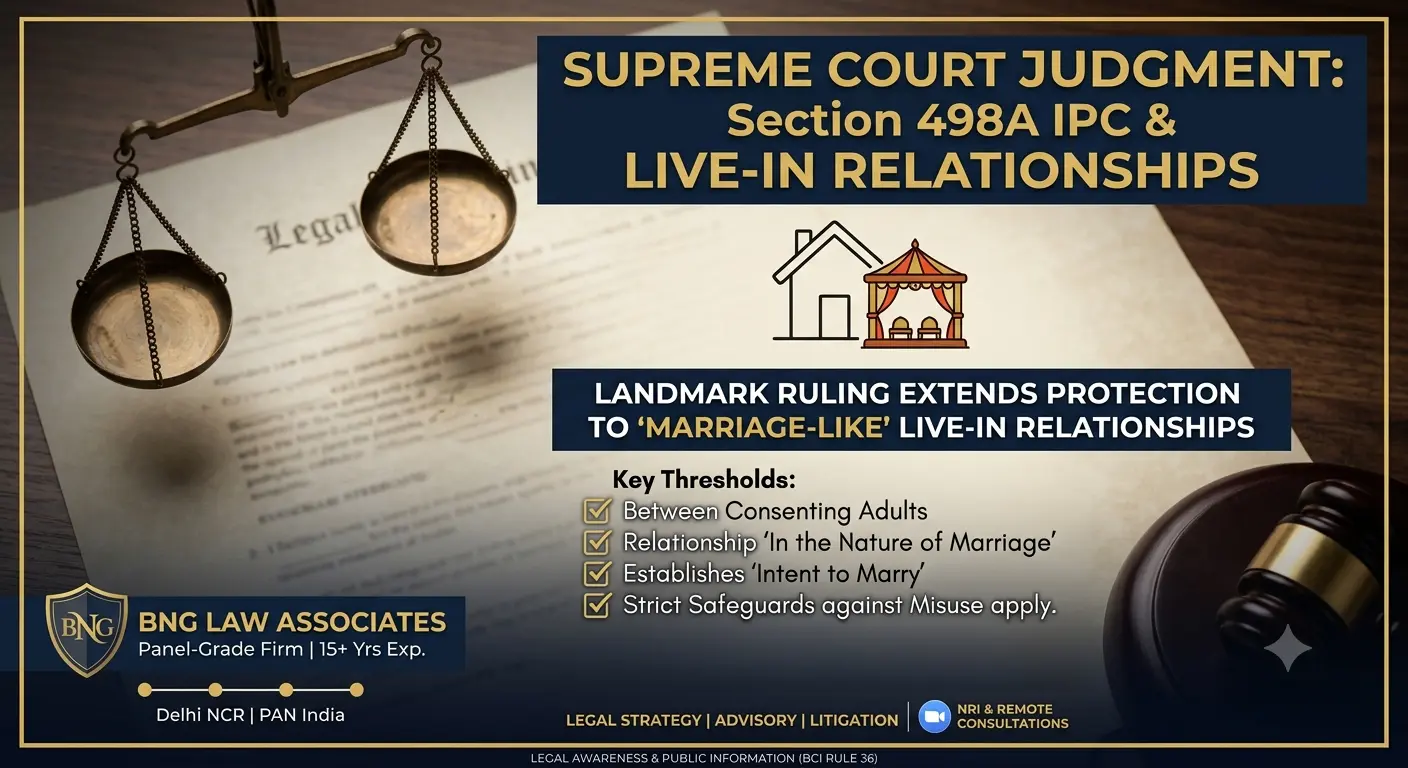
Section 498A IPC and Live-In Relationships: Does the Law Apply If You Were Never Legally Married?
Can 498A be filed without marriage? Can Section 498A IPC apply to a live-in relationship where the couple was never legally married? For years, those questions kept coming back in Indian courtrooms. On 3 August 2026, the Supreme Court provided important clarity — though the ruling is considerably narrower than many headlines suggest.
In Dr. Lokesh B.H. & Ors. v. State of Karnataka & Anr. (2026 INSC 784), a bench of Justices Sanjay Karol and N. Kotiswar Singh held that Section 498A IPC can reach a live-in relationship, but only if it genuinely functioned like a marriage and the parties intended to marry. That difference matters enormously if you're on either side of a Section 498A complaint.
I've broken down what the Court actually decided about Section 498A IPC and live-in relationships, what it pointedly did not decide, and what it means practically — whether you're the one filing a complaint, the one defending against it, or watching this unfold from outside India.
The Case Behind the Ruling
Dr. Lokesh B.H. approached the Supreme Court after the Karnataka High Court refused to quash criminal proceedings against him. The complainant, Smt. Theertha, said the two had married under Hindu rites in October 2010 and lived together in Bengaluru afterward. When the relationship broke down, she filed complaints alleging cruelty, dowry harassment, physical injury, and that Dr. Lokesh had concealed an earlier marriage.
The Karnataka High Court let the case proceed. Dr. Lokesh took it to the Supreme Court, arguing — among other things — that Section 498A is a penal provision meant for a "husband," and shouldn't stretch to cover a relationship whose marital validity was itself disputed.
The Supreme Court disagreed and let the trial continue. But it used the case to lay down a broader rule for every live-in dispute that might raise the same question.
Does Section 498A IPC Apply to Live-In Relationships?
Yes — but only to a specific kind of live-in relationship, not to every couple who happens to share an address.
The Court's reasoning turns on two central requirements: the relationship must qualify as a "relationship in the nature of marriage," and an intention to marry must be established. A short fling, a casual arrangement, or two people who dated while keeping separate homes and separate finances won't clear this bar just because they occasionally stayed together.
This is worth sitting with for a moment, because it cuts against the way this judgment has been summarised in a lot of quick takes online. The Court did not say live-in relationships are now treated as marriages. It said a specific category of live-in relationship — long-term, marriage-like in substance, with a demonstrable intent to marry — falls within Section 498A IPC's protection.
What Actually Makes a Relationship "in the Nature of Marriage"?
Indian courts have wrestled with this phrase before, mostly under the Protection of Women from Domestic Violence Act, 2005 (PWDVA), which uses similar language. The idea isn't new — it's about relationships that never went through a formal ceremony but function, in every practical sense, like a marriage.
Judges typically look at things like:
- How long the couple was together and how stable that period was
- Whether they actually shared a household, not just occasional overnight stays
- Whether their finances and daily lives were genuinely intertwined
- How they presented themselves to family, friends, neighbours, and on official records
- Whether they took on responsibilities you'd normally associate with a married couple
None of these are boxes to tick mechanically — courts weigh the whole picture. A couple who built a life together over a decade, ran a shared household, and told everyone they were married looks nothing like two people who dated for eight months while living separately. Since Section 498A is a criminal provision, the Court was careful to say that romantic involvement or physical intimacy alone proves nothing.
Why "Intent to Marry" Is Doing So Much Work in This Judgment
If there's one part of this ruling to remember, it's this: the Court didn't just ask whether the relationship looked like a marriage. It asked whether the couple actually meant to get married.
That requirement is what keeps the ruling from swallowing every live-in relationship in the country. It's not enough to show cohabitation, however long. There has to be something — conduct, communications, how the couple described their plans to others — pointing to a genuine, shared intention to formalise the relationship eventually. Whether that intent existed is a factual question the trial court will have to work out case by case; there's no shortcut around it.
What This Judgment Does Not Do
This is the part that gets lost fastest in social media summaries, so it's worth being blunt about it. Lokesh B.H. does not mean:
- Every live-in relationship is now legally equivalent to a marriage
- Every breakup or dispute between live-in partners amounts to criminal cruelty
- A Section 498A complaint automatically triggers an arrest
- A complainant is excused from proving the actual elements of the offence
- Every relationship recognised under the PWDVA automatically becomes a Section 498A case
- The reasoning extends to any provision beyond Section 498A itself
The Court was explicit that its interpretation is confined to Section 498A IPC and doesn't automatically carry over elsewhere — a point that becomes important once you factor in India's new criminal code.
What About Section 85 of the Bharatiya Nyaya Sanhita?
Section 498A IPC has technically been replaced by Section 85 of the Bharatiya Nyaya Sanhita, 2023 (BNS) for offences committed after the new code took effect. Because the two provisions cover essentially the same ground — cruelty by a husband or his relatives — it's tempting to assume this ruling automatically applies to Section 85 as well.
Resist that assumption. The Supreme Court's decision arose under Section 498A IPC and was expressly limited to it. Whether the same reasoning applies to Section 85 BNS is a separate legal question that will likely need its own determination, and the answer may depend on when the alleged conduct occurred and which statute actually governs the case. Some commentators reading the judgment have suggested the Court's language leaves room for the reasoning to extend to Section 85 — but that's an inference, not something the Court decided outright, so treat it as an open question rather than settled law until a court says so directly.
Arrest Isn't Automatic — the Arnesh Kumar Safeguards Still Apply
Nothing in this ruling changes how arrests in Section 498A IPC cases are supposed to work. The Court reaffirmed the safeguards from Arnesh Kumar v. State of Bihar, (2014) 8 SCC 273, which require the police to comply with the statutory safeguards governing arrest and to assess whether arrest is actually necessary in the circumstances.
That protection cuts both ways. An accused person shouldn't be arrested reflexively the moment a complaint is filed. At the same time, those safeguards don't strip a genuine complainant of her right to seek protection where the facts support it.
Filing a Section 498A Complaint From a Live-In Relationship: What to Preserve
If your relationship genuinely had the shape of a marriage — long-term, cohabiting, financially and emotionally intertwined, with a real intention on both sides to marry — this judgment gives you a criminal remedy that wasn't clearly available before. But the outcome will turn heavily on what you can show.
Worth preserving early, before memories fade or documents go missing:
- Anything establishing how long you lived together and how the household ran
- Records of shared or interdependent finances
- Messages or communications where marriage was discussed or planned
- How the relationship was described to family and friends
- Medical records, if there was physical injury
- Anything documenting the alleged cruelty itself
You don't need a complete file before you go to the police. But the earlier you start preserving this material, the stronger your position tends to be later.
If You've Been Accused Under Section 498A IPC
Don't assume the absence of a formal wedding automatically ends the case against you — after this ruling, it may not. But don't assume the opposite either. A complaint isn't a conviction, and the prosecution still has to prove the relationship met the Court's two-part test and that the alleged cruelty actually happened.
Questions worth working through with a lawyer early rather than late:
- Did the relationship actually have the stability and shared-life characteristics of a marriage, or is that being overstated?
- Is there real evidence of an intent to marry, or is that missing?
- Do the specific allegations meet the legal definition of cruelty?
- Have the Arnesh Kumar arrest safeguards actually been followed in your case?
- Is there a basis to seek quashing under Section 482 CrPC (or its BNS equivalent)?
Avoid deleting messages, editing records, or making statements before getting advice — in a case that will likely turn on documented conduct, that kind of self-help can do more damage than the original complaint.
The NRI Angle
This ruling isn't just a domestic concern. NRIs who had relationships in India before moving abroad, or who are named in complaints filed after they've left, sometimes assume physical distance insulates them. It doesn't — being outside India does not, by itself, prevent an FIR, summons, or warrant from moving forward, and ignoring a proceeding tends to make the eventual legal position worse, not better.
If you're outside India and a complaint has already been filed, the right response — bail applications, anticipatory bail, quashing petitions, coordinating through power of attorney — depends heavily on the stage the case is at. That's a conversation to have with counsel as soon as you're aware of the proceeding, not after a warrant has already been issued.
Labels Matter Less Than Facts
The single most useful takeaway from this judgment, for anyone actually caught up in one of these disputes, is that calling a relationship a "marriage" or a "live-in relationship" settles nothing on its own. What the courts will look at is what actually happened — the household, the finances, the way the relationship was lived and represented. The exact same category of evidence — a shared lease, joint bank statements, family photos — can point in opposite directions depending on whether you're building the case or defending against it. That's precisely why these disputes reward a fact-heavy legal strategy over an argument that hinges purely on a label.
How BNG Law Associates Can Help
We handle criminal and matrimonial disputes arising from both formal marriages and live-in relationships, including Section 498A IPC defence and complaints, domestic violence proceedings, and the added complications that come with NRI clients. That includes early-stage risk assessment before a matter escalates, evidence review, representation before trial courts and the Delhi High Court, and coordination for clients living outside India who need representation here.
If you're facing a Section 498A complaint arising from a live-in relationship — as a complainant or an accused — the appropriate legal response depends on the specific facts, evidence, and stage of the proceedings, not a general read of the judgment.
Frequently Asked Questions
Can 498A be filed without marriage?
Yes, where the relationship qualifies as one "in the nature of marriage" between consenting adults with an established intent to marry. Not every live-in relationship meets that bar.
Can Section 498A IPC apply to a live-in relationship?
Yes, under the same test above — a marriage-like relationship plus an established intent to marry. Cohabitation alone isn't enough.
Does every live-in relationship count as a "relationship in the nature of marriage"?
No. Courts look at the relationship's duration, stability, shared household, and other substantive factors — not just the fact that two people lived together.
Is intent to marry actually required, or is cohabitation enough?
Intent to marry is a separate, necessary requirement under this ruling. Long cohabitation alone doesn't satisfy it.
Can a woman file a Section 498A case against a live-in partner?
She can, if the facts meet the Court's test. Whether it succeeds depends on the relationship's nature and the evidence of cruelty.
Does this mean live-in partners can now be arrested automatically under Section 498A?
No. The Arnesh Kumar safeguards on arrest still apply in full.
Does the ruling automatically apply to Section 85 of the BNS?
The Supreme Court limited its holding to Section 498A IPC. Whether it extends to Section 85 BNS remains an open question rather than settled law.
Can proceedings under this ruling be quashed?
In appropriate cases, yes, through the High Court's inherent jurisdiction — but the absence of a formal marriage doesn't by itself determine the outcome.
What evidence matters most in these cases?
Proof of a shared household, financial interdependence, social representation as a couple, communications about marriage plans, and documentation of the alleged cruelty.
This article is for general information only and isn't legal advice. Outcomes in matters like this depend heavily on the specific facts, evidence, and procedural posture of a case. If you're dealing with a Section 498A matter, speak with a qualified advocate about your circumstances.
Primary source: Dr. Lokesh B.H. & Ors. v. State of Karnataka & Anr., 2026 INSC 784 — full judgment, Supreme Court of India, decided 3 August 2026.
.jpeg)

Comments (0)
Abhi tak koi comment nahi hai. Sabse pehle comment karein!
Apna Comment aur Rating dein