

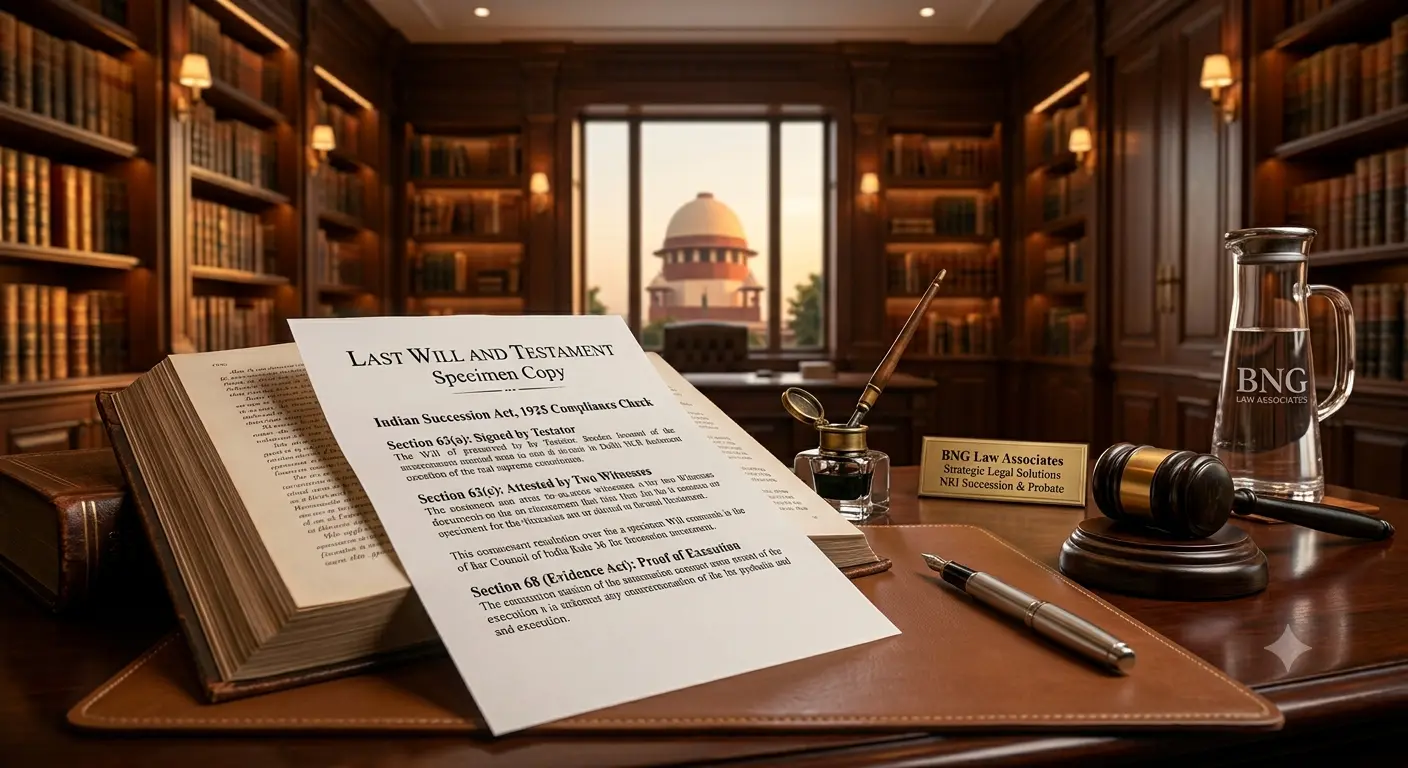
How to Prove a Will in India: What the Supreme Court Actually Requires
A client once brought me a Will — registered, notarised, the works — and said, "This can't be challenged, right?"
I had to tell him it absolutely could be.
That misunderstanding is behind more failed succession strategies than anything else I see in this practice, so it's worth starting there.
Registration does not make a Will immune from challenge. It's a relevant circumstance a court may weigh. It is not, by itself, proof that the Will was validly executed, properly attested, or free of circumstances that raise doubt about its genuineness.
Wills are treated differently from most legal documents for one simple reason: by the time a dispute arises, the person who made the Will can no longer explain what they intended or how the document came to be signed. The court can't ask the testator whether they signed voluntarily, understood what they were signing, or were under pressure from someone in the room.
That's why Indian law — mainly through Section 63 of the Indian Succession Act, 1925 and Sections 68–69 of the Indian Evidence Act, 1872 — builds in safeguards for the execution and proof of a Will that ordinary documents don't need.
The Supreme Court has shaped these safeguards through a long line of decisions, starting with a Constitution Bench ruling in 1958 that trial courts still cite every week. This article walks through what the law and the leading cases actually require, where NRI-linked property disputes tend to get harder, and how a Will can be challenged — or defended — once a dispute starts.
For anyone involved in proving a Will in court in India, understanding these requirements is essential before relying on the document in a succession or property dispute.
The Three Questions Every Contested Will Usually Comes Down To
Every succession dispute has its own facts, but most contested Will cases eventually narrow to three questions:
- Was the Will properly executed?
- Was it attested the way the law requires?
- Can its execution actually be proved in court, with admissible evidence?
Other issues — testamentary capacity, coercion, undue influence, fraud, suspicious circumstances — layer on top of these three depending on what's actually being disputed. Everything below fits somewhere in this framework.
-
Execution: Section 63 of the Indian Succession Act
The basic rule is simple. The testator signs the Will, or directs someone else to sign it in their presence and under their direction. The signature has to appear in a way that shows the document was meant to operate as a Will — not a draft, a note, or an unfinished instruction to a lawyer.
Where it gets difficult is proving that execution actually happened the way it's claimed.
The foundational Supreme Court authority here is H. Venkatachala Iyengar v. B.N. Thimmajamma, AIR 1959 SC 443, a Constitution Bench decision that still gets cited in nearly every contested Will case I've worked on. The Court held that the propounder — the person putting the Will forward — must establish that it was duly and validly executed. Where suspicious circumstances surround that execution, the propounder may have to go further and satisfy the "judicial conscience" of the court that the document genuinely reflects the testator's last wishes.
One fact pattern the Court flagged as potentially relevant: a person who was closely involved in preparing or arranging the Will, and who also stands to benefit substantially from it. That combination doesn't automatically doom a Will, but depending on the surrounding facts, it's exactly the kind of thing that invites closer scrutiny.
In practice, a contested Will may require the propounder to prove due execution, address the testator's capacity where it is genuinely in issue, and satisfactorily explain any suspicious circumstances raised by the evidence.
-
Attestation: Two Witnesses, No Shortcuts
A signature by itself doesn't establish valid attestation. Section 63(c) requires at least two witnesses, and each of them has to have done one of the following:
• Watched the testator sign or affix a mark, or • Watched someone else sign on the testator's behalf and instruction, or • Personally heard the testator acknowledge that the signature is theirs.
Each witness then has to sign the Will themselves, in the testator's presence.
This sounds like a formality until you've sat through a hearing where the entire case turned on whether a witness was actually in the room that day, or signed three weeks later as a favour. I've seen both happen. Attestation exists precisely because it's the only real-time check on a document that will only be examined after the person who made it can no longer speak to it — which is exactly why the attesting witnesses often end up being the most important evidence in the whole case.
-
Proof in Court: Section 68 of the Evidence Act
Execution and attestation aren't boxes you tick and forget. When a Will is relied on in court, its execution generally has to be proved under the ordinary rules of evidence.
Section 68 of the Evidence Act says a document that the law requires to be attested can't be used as evidence unless at least one attesting witness has been called to prove it — provided a witness is alive and can be found.
Jaswant Kaur v. Amrit Kaur, (1977) 1 SCC 369, is one of the key Supreme Court decisions on this point, dealing with the propounder's burden and the effect of suspicious circumstances. The broader principle it reinforces: the person relying on the Will has to establish the facts needed to prove due execution, and where the evidence itself raises suspicion, that suspicion needs a satisfactory explanation before the court will accept the document — even without a formal allegation of fraud on record. Sometimes the circumstances alone are enough to demand a closer look.
Where a challenge goes further — capacity, coercion, undue influence — courts look past attestation entirely, into medical records, correspondence, and how people behaved around the time the Will was signed.
When the Witnesses Are Gone: Section 69
This isn't a rare problem. Wills sit untouched for decades, and by the time a dispute starts, the attesting witnesses have often died or can't be traced.
Section 69 of the Evidence Act provides a fallback: establish that at least one attestation is genuinely in that witness's handwriting, and that the testator's own signature is authentic.
Shashi Kumar Banerjee v. Subodh Kumar Banerjee, AIR 1964 SC 529, another Constitution Bench ruling, is the case most often cited on how far this kind of evidence can carry a party. The Court's message was blunt: handwriting-expert opinion is weak evidence on its own and rarely substitutes for direct or circumstantial proof — it has to be weighed alongside everything else, not treated as decisive by itself.
Practically, that means an old Will with no surviving or traceable witnesses is a genuinely harder document to prove. It's exactly the situation where preparing evidence early — long before anyone disputes anything — makes the biggest difference later.
Registration Will Not Cure Defects in a Will
Worth saying plainly: a registered Will is not beyond challenge.
Registration is one circumstance a court may consider. It doesn't establish that the Will was properly executed and attested, and it doesn't erase suspicious circumstances surrounding the document. A registered Will can still be challenged on:
• Defective execution or attestation • A disputed or allegedly forged signature • Questions about testamentary capacity • Coercion or undue influence • Fraud • Suspicious circumstances in how the document was prepared or signed
Registration is one part of the evidentiary picture. It was never meant to be the whole picture.
What Makes a Will "Suspicious"?
There's no fixed checklist that automatically invalidates a Will — courts look at the facts as a whole — but certain patterns come up often enough in the cases I've reviewed to be worth naming:
• A major beneficiary closely involved in drafting or arranging the signing
• Natural heirs excluded with no explanation anywhere in the document
• Bequests that don't fit anything the testator was known to want
• Overwriting, corrections, or inconsistencies left unexplained
• A signature that looks off, or is directly disputed
• Real doubt about the testator's physical or mental state at the relevant time
• A vague or shifting account of how and where the Will was actually prepared
No single circumstance automatically invalidates a Will, and courts examine the evidence as a whole. But when two or three of these show up together, the propounder's job gets noticeably harder — that's the Venkatachala Iyengar test doing exactly what it was built to do.
How Can a Will Be Challenged in India?
A Will can be challenged on several grounds, and which one applies depends entirely on the facts. The most common, in my experience, are:
• Failure to meet the legal requirements for execution or attestation
• Allegations that the signature is forged or not genuine
• Questions about the testator's capacity at the time of signing
• Allegations of coercion, fraud, or undue influence
• Suspicious circumstances surrounding preparation or execution
• Doubt over whether the document really reflects the deceased's final intentions
Raising an allegation doesn't invalidate a Will by itself — the outcome turns entirely on the evidence put before the court. If you're considering a challenge, the more useful exercise is usually identifying the specific evidentiary weakness in the document, rather than arguing generally that the Will is "unfair" or "doesn't make sense." Courts respond to the former far more than the latter.
Whose Job Is It to Prove the Will?
The initial burden lies on the propounder — the person relying on the Will. The propounder has to establish due execution and attestation, and where the evidence raises suspicious circumstances, explain those circumstances satisfactorily before the court will accept the document as genuine.
What counts as "satisfactory" depends entirely on what's actually being questioned. Producing more copies of the same signed document doesn't answer a question about whether a witness was present. If the dispute is about capacity, the evidence needs to speak to capacity — medical records, contemporaneous accounts, not just more paper bearing the same signature. In my experience, cases are won or lost on how directly the evidence addresses the actual doubt in front of the judge, not on how much evidence gets filed overall.
NRI Wills and Property Disputes: Where It Gets Harder
A growing share of the disputes I handle now involve family members living outside India. The legal requirements don't change because someone lives abroad — what changes is how hard they are to satisfy. Common friction points include:
• A Will signed while the testator was living overseas
• Attesting witnesses who now live abroad and are difficult to trace or produce
• Records and documents scattered across two or three jurisdictions
• Ancestral or jointly-held property layered into the dispute
• Uncertainty over whether probate is required, which depends on where the property sits and which personal law applies
My honest advice to NRI clients dealing with Indian property under a Will — theirs or a relative's — is to get it reviewed early. Reconstructing a decade-old signing from another time zone, after a dispute has already started, is a far worse position than sorting out the evidence while everyone involved is still reachable.
Preserving Evidence That May Support a Will Later
Most of the evidentiary problems I see trace back to one thing: nobody thought a dispute was coming when the Will was signed. If you're in a position to plan ahead, it's worth holding onto:
• The original Will, not just a scanned copy
• Full, current contact details for both attesting witnesses
• Medical records, if capacity might ever come into question
• Correspondence from the period the Will was actually drafted
• Property documents that match what the Will describes
• A written account of how the signing happened — who was present, where, and when
None of this guarantees a Will survives a challenge. All of it makes the challenge harder to win.
Frequently Asked Questions
Can a registered Will still be challenged in India?
Yes. Registration is one relevant circumstance among several. It doesn't override the requirements of execution, attestation and proof, and it doesn't automatically resolve suspicious circumstances surrounding the document.
How many witnesses does a Will need in India?
At least two, under Section 63 of the Indian Succession Act, 1925.
How is a Will proved in court?
Generally through the testimony of at least one attesting witness, under Section 68 of the Evidence Act — provided such a witness is alive and can be found.
What happens if both attesting witnesses have died or cannot be found?
Section 69 allows proof through handwriting evidence establishing the witness's attestation and the testator's genuine signature — the standard discussed in Shashi Kumar Banerjee.
Can an NRI make a Will for property located in India?
Yes, subject to the same statutory requirements as any other Will. Where and how it was executed can matter if the document is later disputed.
How can a Will be challenged in India?
On grounds including defective execution or attestation, forgery, lack of testamentary capacity, fraud, coercion, undue influence, or suspicious circumstances — depending on the facts of the case.
Who has the burden of proving a contested Will?
The propounder, throughout the case — including explaining away any suspicious circumstances the evidence raises.
The Bottom Line
A signature and a registration certificate don't end the inquiry. When a Will is contested, courts test whether it was properly executed, whether it was duly attested, and whether the evidence available is enough to prove it — and that scrutiny sharpens fast once capacity, disputed signatures, or suspicious circumstances enter the picture.
For NRI families, this gets more complicated when witnesses, beneficiaries, and property span multiple jurisdictions. The most useful thing anyone can do — on either side of a dispute — is identify the actual evidentiary issue early, whether that's execution, attestation, capacity, or the availability of witnesses, and build the evidence to address that issue directly rather than around it.
Legal Assistance for Will and Succession Disputes
BNG Law Associates advises and represents clients in property, succession and probate disputes, including matters involving NRIs and property located in India. If a Will in your family is being questioned, or you expect one to be, an early review of the document, the witnesses, and the paper trail around it is the single most useful thing you can do before litigation starts.
Schedule a Consultation Office Location: Paschim Vihar, New Delhi, India.
.jpeg)

Comments (0)
Abhi tak koi comment nahi hai. Sabse pehle comment karein!
Apna Comment aur Rating dein