

Electricity Connection in Unauthorized Colonies: What the Andhra Pradesh High Court Actually Decided
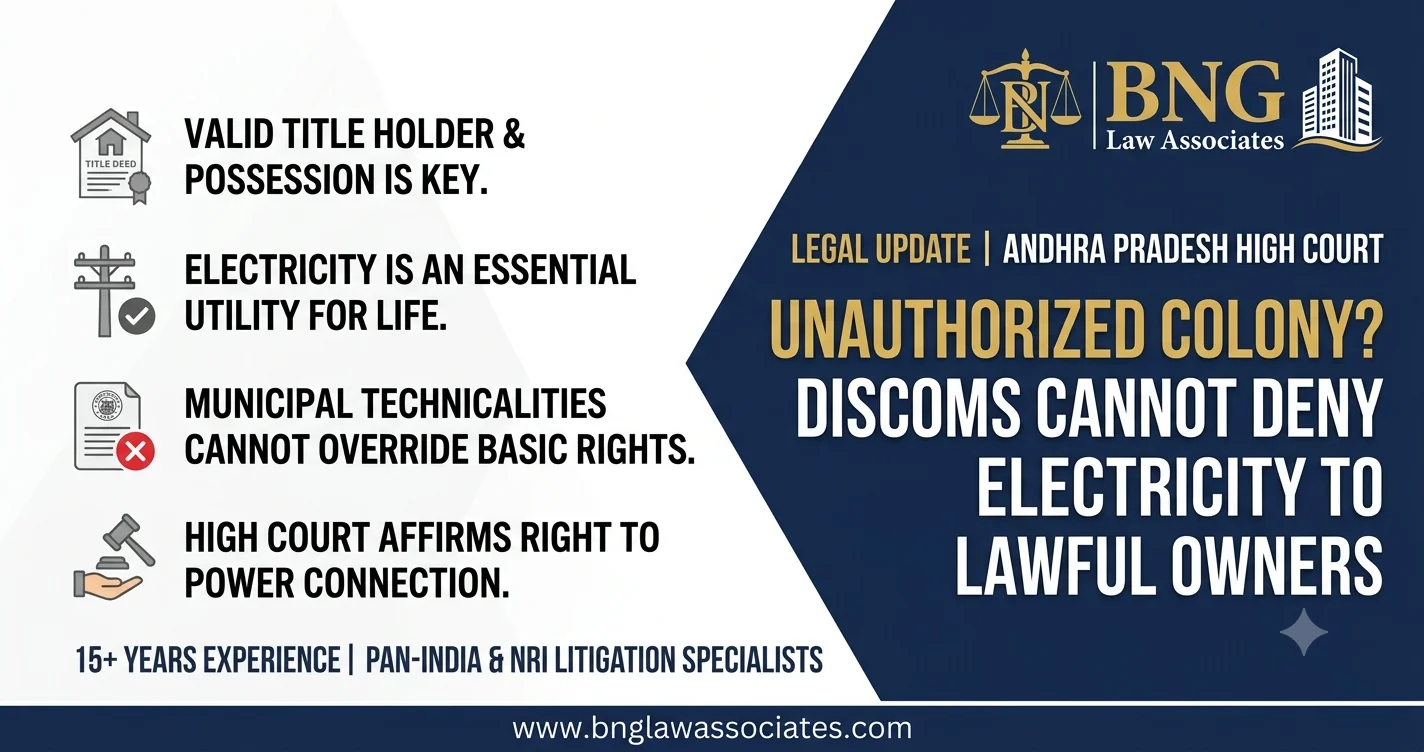
Can a Discom refuse a new electricity connection just because the property sits in a layout that hasn't been officially approved? A recent Andhra Pradesh High Court order says no — not on that ground alone.
In Garikina Satyarao v. State of Andhra Pradesh & Ors., W.P. No. 16579 of 2026, the Court considered whether a homeowner could be denied a domestic electricity connection purely because his layout had been declared unauthorized. The petitioner held a registered sale deed, had built a house on the plot, and was still turned away.
The Court's answer: the unauthorized status of the layout, standing alone, could not defeat an electricity connection claim where the applicant had valid title and possession. The Court also pointed to the General Terms and Conditions of Electricity Supply, under which even a rightful possessor — and, in the circumstances covered by those terms, an encroacher — may be entitled to a connection.
That said, this ruling draws a line that's easy to miss: getting electricity is not the same as getting your property regularized. A Discom connecting your house doesn't make your layout legal. Planning and municipal authorities keep their own powers, untouched by this decision.
Case at a Glance
|
Detail |
Information |
|
Case |
Garikina Satyarao v. State of Andhra Pradesh & Ors. |
|
Case No. |
W.P. No. 16579 of 2026 |
|
Court |
High Court of Andhra Pradesh at Amaravati |
|
Judge |
Justice Venkateswarlu Nimmagadda |
|
Decision Date |
29 June 2026 |
|
Issue |
Electricity connection in an unauthorized layout |
|
Key Legal Provision |
Section 43, Electricity Act, 2003 |
|
Outcome |
Application to be reconsidered; connection to be granted if the applicant is otherwise eligible |
Citation: 2026 LiveLaw (AP) 156.
Does an Unapproved Layout Automatically Block Electricity?
Not on its own, according to this ruling.
The petitioner in Garikina Satyarao bought his plot through a registered sale deed in November 2023 and built a residential house there. When he applied to APEPDCL (Andhra Pradesh Eastern Power Distribution Company) for a domestic connection, the application stalled — the authorities wanted a No-Objection Certificate (NOC) from the Gram Panchayat, among other things.
Justice Venkateswarlu Nimmagadda, hearing the matter at the High Court of Andhra Pradesh in Amaravati, found that the layout's unauthorized status couldn't be used to reject the petitioner outright. He had title, he had possession, and nothing in the supply terms made layout approval an absolute precondition. The Court directed the authorities to process his application within three weeks and grant the connection if he met the other eligibility requirements.
Here's the more precise version of what the Court held:
A Discom cannot treat a layout's unauthorized status, on its own, as grounds to refuse an otherwise eligible applicant.
Technical checks, documentation, and payment of charges can still apply.
What Section 43 of the Electricity Act Actually Requires
Section 43 of the Electricity Act, 2003 puts the duty to supply on the distribution licensee, triggered by an application from the owner or occupier of a premises. That phrase matters — it means the statute isn't written to protect only people with clean, undisputed title.
But Section 43 doesn't override every other requirement. The application still has to meet the standard conditions: charges paid, documents in order, technical compliance met.
So the real question in a disputed case usually isn't "is this layout unauthorized?" It's closer to: is the applicant otherwise eligible, and is the Discom's refusal actually resting on the layout issue — or standing in for some other objection nobody's stated out loud? That distinction decides what remedy is available.
A Connection Doesn't Legalize the Property
Worth repeating on its own, because it's the part people get wrong most often.
Getting electricity does not:
- approve the layout
- regularize the construction
- substitute for municipal building approval
- settle a title dispute
- legalize an encroachment
- stop a planning authority from acting under its own laws
Garikina Satyarao is about the right to seek a connection. It says nothing about whether the layout itself is lawful. Don't treat a live meter as proof your paperwork is clean — those are two separate fights, and only one of them was before this Court.
A Realistic Example
Say a family bought a plot in what's now flagged as an unapproved layout on the edge of a city — a common situation in fast-growing peripheral areas where formal layout approval lags years behind actual construction. They have a registered sale deed, they've built and moved in, and the Discom's field office tells them, verbally, that connections in that layout are "on hold." No written order, no case number, just a shrug at the counter.
That's precisely the gap this ruling addresses. The family's next move isn't to march straight to the High Court — it's to force the refusal into writing first, then work through the grievance channels below before a writ petition even becomes necessary.
If the Discom Refuses Your Application
Start by getting the actual reason — not the version told to you over the counter. "The colony is unauthorized" is not, by itself, a legally sufficient answer, but you need it on paper before you can challenge it.
1. File a complete, documented application. Submit everything the supply rules require, and keep your own copy: application number, acknowledgment, submitted documents, payment receipts, and correspondence with the Discom. If this ends up before a grievance forum or court, this paper trail is what carries the case.
2. Get the refusal in writing. Ask the authority to identify the specific rule or requirement behind the refusal. This tells you whether the objection is really about the layout or whether something else — a missing document, an unpaid charge, a technical issue — is being folded into that explanation.
3. Send a formal legal representation. Lay out your title or possession, the application history, the stated reason for refusal, the relevant provisions of the Electricity Act and supply code, and the relief you're asking for. A properly drafted representation carries more weight than repeated phone calls or counter visits.
4. Approach the Consumer Grievance Redressal Forum (CGRF). The applicable electricity regulatory framework provides a grievance-redressal mechanism for eligible consumer complaints. The specific procedure and timeline depend on the concerned Discom and State Electricity Regulatory Commission.
5. Escalate to the Electricity Ombudsman, if the CGRF doesn't resolve it. Check the applicable regulations for procedure and filing requirements before taking this step.
6. Consider a writ petition under Article 226. Where a Discom has acted arbitrarily, ignored a statutory duty, or rejected an application on a ground that doesn't hold up, a writ — often seeking a mandamus — may be available. This is what happened in Garikina Satyarao: the Court directed the authorities to reconsider and, if eligible, connect the petitioner.
A writ petition is not necessarily the first step. Where an alternative statutory remedy, such as a grievance forum or Electricity Ombudsman, is available, the High Court may consider whether that remedy should be pursued first. However, the appropriate course depends on the facts of the case, the nature of the Discom's refusal, and the remedy being sought.
What Documents Usually Matter
Requirements vary by Discom and state regulation, but expect some combination of:
- identity proof
- proof of ownership or lawful possession
- proof of the premises' address
- the registered sale deed or other title document
- proof of occupancy
- the Discom's application form
- payment of prescribed charges
- documents tied to electrical safety or technical compliance
There's no single national checklist. If a Discom asks for something unusual — like the Gram Panchayat NOC in this case — it's worth asking exactly which rule requires it.
Can a Discom Demand an NOC for a Connection?
Not automatically, just because the property sits in an unauthorized layout. In Garikina Satyarao, the electricity authorities had required an NOC from the Gram Panchayat before processing the application, and the Court held that the layout's unauthorized status alone couldn't justify rejecting the petitioner's claim.
That doesn't mean an NOC can never be required — only that it shouldn't be treated as an automatic, blanket prerequisite. Whether it's genuinely needed depends on the applicable regulations and the specific property.
Layout vs. Building: Not the Same Problem
An unauthorized layout and an unauthorized building are related but distinct issues, and this ruling shouldn't be stretched to cover both automatically.
Municipal and planning authorities retain separate powers over building approvals, land use, demolition, sealing, and any regularization schemes. The electricity authority isn't standing in for the planning authority — it has its own, narrower job. This decision addresses electricity supply; it doesn't touch the building-approval question.
What This Means If You're the Property Owner
If you have a registered sale deed, possession, a completed structure, a pending application, and a refusal that boils down to "the layout is unauthorized" — you likely have grounds to push back on that refusal specifically, provided no independent statutory, technical, or documentary issue exists.
But every case has its own wrinkles. Disputed title, safety concerns, an incomplete application, unpaid charges — any of these can change the analysis even where the layout objection itself wouldn't hold up on its own.
The strongest cases aren't built on saying "my colony is unauthorized, but I want electricity." They're built on showing: "I applied properly, I satisfy the applicable requirements, and the Discom is refusing me solely because of the layout's status."
For NRIs Dealing With This From Abroad
The practical challenge for an NRI owner isn't the law — it's distance. You can't easily make repeat visits to a Discom counter or sit through grievance hearings in person. What usually helps:
- getting title and possession documents reviewed before anything is filed
- having someone draft and send the legal representation on your behalf
- following the grievance process through an authorized local representative
- keeping a complete digital record of applications and correspondence
- coordinating litigation remotely where it becomes necessary
Living outside India doesn't change the underlying legal principles — it just changes how you manage the process.
Quick Checklist If Your Application Was Rejected
- Get the refusal in writing.
- Confirm your application was complete and applicable charges were paid.
- Identify the actual objection — layout status, documentation, technical issue, safety requirement, or something else.
- Check the Electricity Supply Code and regulations applicable to your Discom.
- Ask for the legal basis of any additional document or NOC being demanded.
- Approach the CGRF where the dispute falls within its jurisdiction.
- Consider the Electricity Ombudsman remedy where available.
- If the refusal looks arbitrary or legally unsustainable, get legal advice on a writ petition under Article 226.
Frequently Asked Questions
Can electricity be denied in an unauthorized colony?
Not solely on that basis. In Garikina Satyarao, the Andhra Pradesh High Court held that a layout's unauthorized status couldn't invalidate an otherwise eligible applicant's claim.
Can a Discom refuse electricity because a layout isn't approved?
Not by itself, per this ruling — provided the applicant has valid title and possession. Other eligibility, technical, and documentation requirements can still apply independently.
Can a Discom demand an NOC before connecting an unauthorized layout?
Not as an automatic, blanket rule. This ruling questioned that practice where the applicant otherwise had valid title and possession — though an NOC can still be required where the applicable regulations genuinely call for one.
Does an electricity connection regularize the property?
No. It has no bearing on whether the layout or construction is approved. Municipal and planning authorities keep their powers regardless.
Can an occupier — not just an owner — apply for a connection?
Yes, Section 43 covers both owner and occupier, though eligibility still depends on the applicable supply framework and the facts.
What's the first step if my connection is refused?
Get the reason in writing, confirm your application was complete, and then work through the CGRF or a formal legal notice before considering a writ petition.
Can I go straight to the High Court?
You can, in principle, but a writ petition is usually the last step — after the grievance forum and legal representation haven't resolved things, or where the refusal is obviously arbitrary.
Does an unauthorized layout mean I have no legal rights?
No. Title, possession, planning approval, building approval, and electricity supply are separate legal questions, each governed by its own rules.
Key Takeaway
The Andhra Pradesh High Court's decision in Garikina Satyarao draws a clean line: a layout's unauthorized status, by itself, isn't enough to deny electricity to someone who otherwise qualifies. But it's not a blanket entitlement, and it's not a shortcut to regularizing your property.
If your Discom is refusing a connection purely on layout grounds, the important questions are: What's the actual reason for refusal? Have you met the applicable requirements? Is the Discom relying solely on the unauthorized status of the layout? Those questions should be answered from your documents and the applicable law — not from a statement made at a Discom counter.
How BNG Law Associates Can Help
We work with property owners, businesses, and NRIs on exactly these kinds of disputes — reviewing title documents, drafting the legal representation, handling CGRF and Ombudsman proceedings, and taking writ petitions to the High Court where that's the right move. For NRI clients, we also handle this remotely end to end.
Facing an electricity connection dispute because your property sits in an unauthorized layout? Get your documents and the Discom's refusal reviewed before deciding your next step.
BNG Law Associates Delhi NCR | PAN India | NRI Legal Support Website: www.bnglawassociates.com
Disclaimer: This article is for general legal information and isn't legal advice. Electricity-supply requirements, grievance procedures, and remedies vary by state, Discom, and the facts of the individual case. Consult a lawyer for advice specific to your property or dispute.

.jpeg)

Comments (0)
Abhi tak koi comment nahi hai. Sabse pehle comment karein!
Apna Comment aur Rating dein