

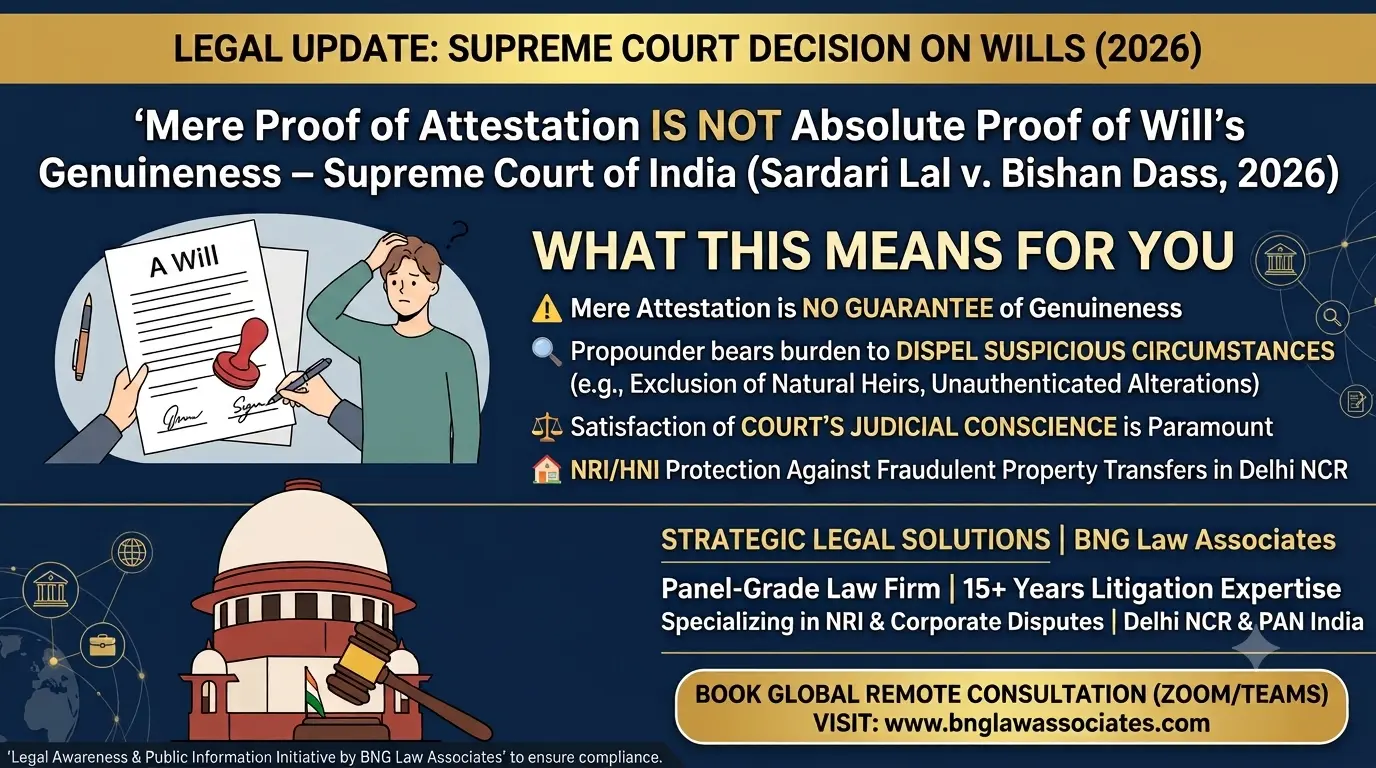
Can a Registered Will Still Be Challenged in India? The Supreme Court's Answer in Sardari Lal v. Bishan Dass
A Will can look bulletproof on paper — signed, witnessed, even registered — and still fail to hold up in court. That is the practical reality behind a Supreme Court decision handed down on 6 July 2026, and it is one I see catch families off guard again and again: registration records the execution and presentation of the document; it does not by itself establish that the Will genuinely reflects the free and informed intention of the testator.
Disputes over Wills tend to surface at the worst possible time — when a Will excludes a spouse or child, hands a large share of the estate to someone who helped draft it, or simply reads oddly given what the family knows about the deceased's wishes. For Non-Resident Indians managing inherited property from abroad, the problem is compounded: an alleged Will often surfaces years later, once a mutation entry or a rival claim forces the issue.
In Sardari Lal v. Bishan Dass & Ors. [2026 INSC 669 / 2026 LiveLaw (SC) 655], a two-judge Bench of Justices Manoj Misra and K.V. Viswanathan revisited a principle that courts must continue to apply carefully when suspicious circumstances surround a Will: proving execution and attestation is the beginning of the inquiry into a Will, not the end.
The Facts: An Illiterate Farmer, an 18-Year Gap, and a Disinherited Widow
The dispute traced back to Chhajju Ram, an illiterate agriculturist who died in 1992, eighteen years after allegedly executing a registered Will in 1974. Under that Will, his property went to Bishan Dass and others — not to his wife, Bhambo Devi, who as his sole Class I heir would ordinarily have inherited everything by intestate succession.
Bhambo Devi challenged the Will, arguing it was never genuinely executed and, in the alternative, that it was procured by fraud and undue influence. She died while the litigation was pending, and her legal representative, Sardari Lal, carried the case forward — a dispute that outlived the original widow, continuing for years after her death under his representation and eventually reaching the Supreme Court in her stead.
The trial court and the first appellate court both rejected the Will, pointing to several unexplained features: the complete disinheritance of a dependent, cordial spouse in favour of comparative strangers; the testator's illiteracy; and — most damaging — unauthenticated cuttings on the Sub-Registrar's endorsement at the back of the document. The High Court reversed this in second appeal, reasoning that once the attesting witness had been examined, execution stood proved and nothing more needed answering.
The Supreme Court disagreed. It restored the trial court's rejection of the Will, holding that the High Court had impermissibly disturbed concurrent findings of fact under Section 100 CPC, and reaffirmed that examining an attesting witness answers only one question — whether the document was signed — not whether it reflects the testator's free and informed intention.
Why Attestation Isn't the End of the Story
Section 63 of the Indian Succession Act, 1925 and Section 68 of the Indian Evidence Act, 1872 set out the formal requirements for proving a Will: signature, attestation by at least two witnesses, and examination of an attesting witness in court. Chhajju Ram's Will satisfied all of this.
That was precisely the point the Supreme Court corrected. Formal proof of attestation establishes that a document was signed and witnessed — it does not, on its own, establish that the document represents the genuine, voluntary intention of the testator. Where such circumstances give rise to legitimate suspicion, the propounder must satisfactorily explain them and establish that the Will represents the free and informed intention of the testator.
What Counted as "Suspicious" in This Case — and What Generally Does
There is no fixed checklist for suspicious circumstances; each case turns on its own facts. But Sardari Lal illustrates the categories courts return to most often.
1. Disinheriting a Dependent Spouse Without Explanation
Bhambo Devi was not a distant relative with a weak claim — she was Chhajju Ram's wife and sole legal heir, and nothing in the record explained why she was cut out entirely in favour of others. A testator is generally free to distribute property however they choose, and exclusion alone doesn't sink a Will. But when a dependent, cordial spouse is disinherited with no stated reason, courts expect the propounder to explain it — and silence counts against them.
2. Unauthenticated Alterations
The cuttings on the Sub-Registrar's endorsement page were never explained by anyone, and the Sub-Registrar who should have verified them was never called to testify. Courts treat unexplained cuttings, overwrites, or corrections on a Will as a red flag precisely because they open the door to post-execution tampering — and the burden falls on the person relying on the document to show otherwise, not on the challenger to prove foul play.
3. The Testator's Capacity and Circumstances
Chhajju Ram's illiteracy was a relevant factor here — an illiterate testator depends entirely on someone else to read the document back to them accurately, which raises the stakes on proving they actually understood what they were signing. The Court also weighed the 18-year gap between execution and death: not as an automatic red flag (a Will made decades before death is not inherently suspect), but as a factor that reinforced the other doubts, since a testator with "many years to live" might reasonably be expected to provide for a dependent spouse or explain why he didn't.
4. Unusual Relationships or Roles of Beneficiaries
Where a beneficiary is described in a Will as a caretaker or close relation, and that description doesn't match the evidence, it feeds into the same inquiry. Similarly, active involvement by a major beneficiary in drafting or arranging execution isn't automatically disqualifying, but it invites scrutiny — particularly where that person also stands to gain the most.
What "Registered" Actually Proves
This is the point worth underlining for anyone assuming a registered Will is unassailable: registration is a relevant circumstance, but on its own it says nothing about whether the testator freely and knowingly intended the contents. The Supreme Court's ruling in Sardari Lal makes clear that a registered Will with unexplained alterations and an unexplained disinheritance can still be rejected — registration didn't save it, and neither did a properly examined attesting witness.
For Natural Heirs Considering a Challenge
Being left out of a Will isn't, by itself, grounds to challenge it — a valid Will overrides the ordinary rules of succession. What actually matters is whether the surrounding facts raise genuine doubt. Worth examining:
- Was the Will properly executed and attested, and can the witnesses actually be traced and questioned?
- Are there alterations, cuttings, or corrections that no one has explained?
- Was the testator capable — physically, mentally, and in terms of literacy — of understanding what they signed?
- Did a major beneficiary play an outsized role in preparing or arranging the Will?
- Does the stated relationship between testator and beneficiary hold up against other evidence?
- Does the exclusion of a natural heir fit a pattern with the above, rather than standing alone?
What This Means for NRIs
In my experience advising clients in property and inheritance disputes, NRIs can face additional practical difficulties when an alleged Will surfaces after they have been outside India for several years.
In some cases, an alleged Will may surface only after a mutation entry has already been initiated or completed, or after a sibling or relative in India begins asserting rights over the property. Being abroad can make three things harder — tracing attesting witnesses years later, obtaining certified copies of the registration record (including the Sub-Registrar's endorsement page, which was relevant in this case), and acting within applicable limitation periods.
If you're an NRI and a Will has surfaced unexpectedly, the practical priority is usually to get certified copies of the registered document and its endorsement page immediately, identify and preserve contact details for the attesting witnesses before memories fade or people become untraceable, and file a caveat where relevant to prevent probate or succession proceedings from moving forward without notice to you. The right strategy still depends on which state the property sits in, whether probate is mandatory there, and what stage the local proceedings have reached.
Drafting a Will That Won't Be Easy to Challenge
The same factors that sank the Will in Sardari Lal are a useful checklist for anyone drafting their own.
Name everyone clearly. Ambiguity about who the testator or beneficiaries are invites competing claims later.
Choose attestable witnesses. Pick witnesses who are likely to still be alive, traceable, and willing to testify years down the line — not just anyone available on the day.
Never leave a correction unexplained. Every alteration should be initialled by the testator and the witnesses at the time it's made, not left for a court to puzzle over decades later.
Write down the reason for an unusual choice. If you're leaving out a spouse or child, or leaving most of the estate to someone outside the immediate family, a contemporaneous explanation or a carefully drafted clause is often the single most useful piece of evidence if the Will is later contested.
Get medical evidence when capacity could be questioned. This isn't necessary for every Will, but if you're elderly, unwell, or in any situation where testamentary capacity could later be doubted, a contemporaneous medical opinion can help address future disputes concerning testamentary capacity.
Frequently Asked Questions
Can a registered Will be challenged in an Indian court?
Yes. Registration is relevant evidence but not conclusive proof of genuineness. Where suspicious circumstances exist, a registered Will can still be rejected, as it was in Sardari Lal v. Bishan Dass.
Does excluding a spouse or child automatically invalidate a Will?
No. A testator can generally distribute property as they choose. But an unexplained exclusion of a dependent natural heir, especially combined with other doubts, adds to the suspicious circumstances the propounder must address.
What happens if an attesting witness has already been examined in court?
Examining an attesting witness proves execution was formally observed — it does not, by itself, prove the Will reflects the testator's genuine and voluntary intention if other suspicious circumstances remain unexplained.
Key Takeaway
Sardari Lal v. Bishan Dass is a reminder that formal compliance and genuine intention are two different questions. A Will that ticks every procedural box — signed, witnessed, registered — can still fail if the surrounding facts, like an unexplained disinheritance or unauthenticated cuttings on the record, are never satisfactorily explained. For heirs, that means a challenge can succeed on more than paperwork gaps. For anyone drafting a Will, it means the safest document is one that leaves as little unexplained as possible.
Disclaimer: This article is intended for general legal awareness and public information only. It does not constitute legal advice. The legal position applicable to a disputed Will depends on the specific facts, evidence, and circumstances of each case.

.jpeg)

Comments (0)
Abhi tak koi comment nahi hai. Sabse pehle comment karein!
Apna Comment aur Rating dein