
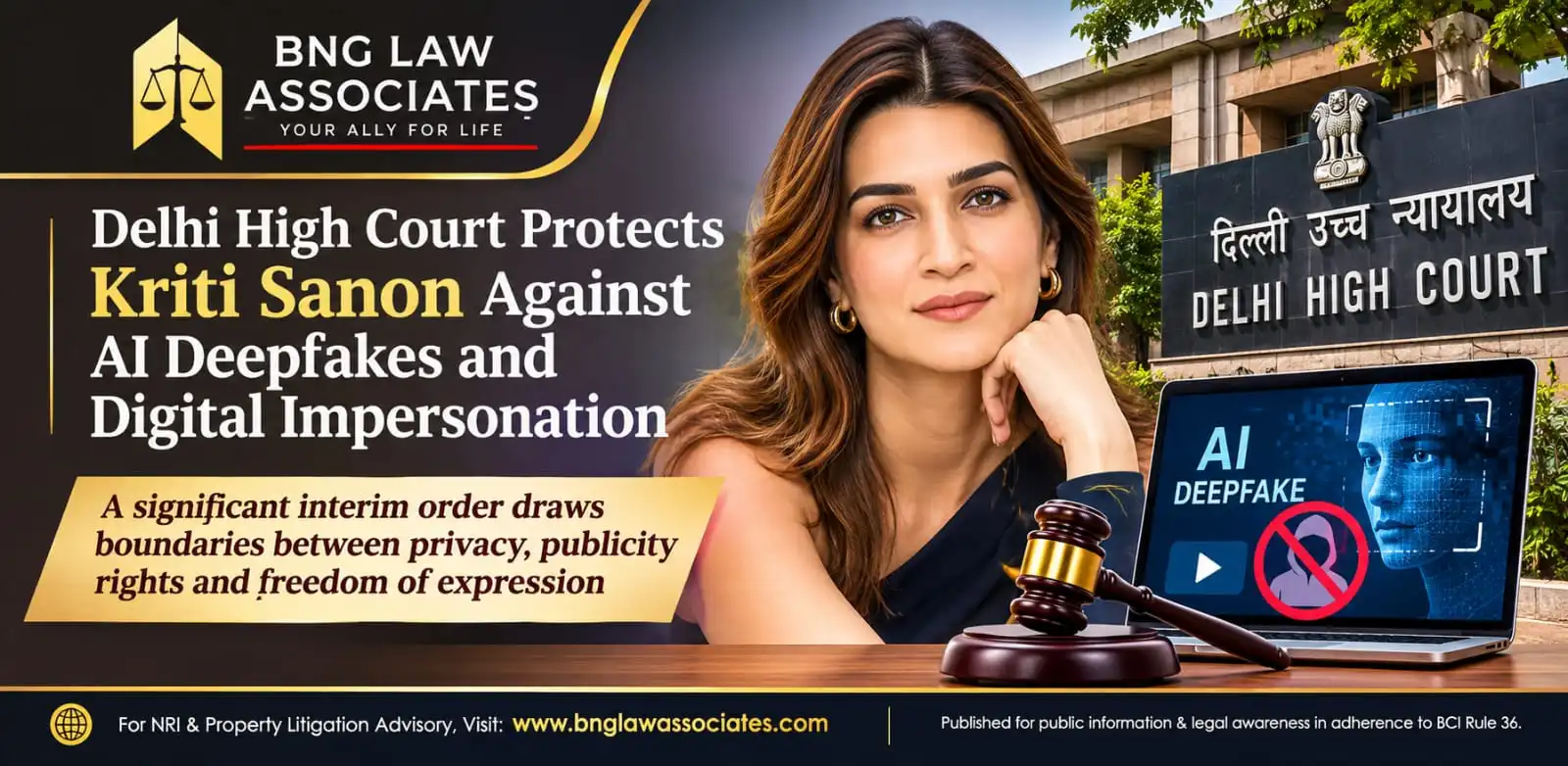
Kriti Sanon Deepfake Case: Delhi High Court on Personality Rights and AI Impersonation
A reasoned ad interim order separates privacy, publicity rights and free speech, and shows how takedown requests should be framed.
Key Takeaways
- On 29 October 2026, Justice Purushaindra Kumar Kaurav of the Delhi High Court granted actor Kriti Sanon ad interim protection against sexually explicit deepfakes, impersonating accounts, AI chatbots and voice models presented as her, and similar merchandise.
- The Court held that "personality rights" is not a single cause of action. It is a label for several distinct claims, each with its own requirements.
- These protections belong to every individual, not only celebrities. At the same time, the mere use of someone's identity is not unlawful by itself.
- The Court refused an omnibus injunction. Relief is tied to identified URLs and defined categories of content, and news, reviews, criticism, satire, parody, caricature and fan expression are expressly left untouched.
- The order is ad interim and prima facie. The suit returns to the Court on 10 December 2026.
Introduction
Generative AI can now reproduce a person's face, voice and mannerisms with striking realism. Used well, that is a creative tool. Used badly, it produces sexually explicit deepfakes, fake accounts and synthetic voices that speak as a real person without her consent. The harm is not limited to embarrassment. It reaches dignity, privacy, reputation and, for public figures, the commercial value of their identity.
The Delhi High Court addressed these concerns on 29 October 2026 in Kriti Sanon v. BBE Marketing Inc. & Ors. Beyond the takedown and restraint directions, the order does something more useful for lawyers, creators and platforms: it asks what "personality rights" actually means in Indian law, and answers that it does not mean one thing.
What Was Before the Court?
Sanon complained of five kinds of misuse of her name, image, likeness and voice:
- A website offering "bookings" for her appearances.
- Accounts on YouTube, Facebook, X and Pinterest presenting themselves as her official presence, or circulating AI-generated and morphed images, some of them sexually suggestive.
- Sale of merchandise.
- AI chatbots and synthetic voice models presented as her, along with a tool that generates her images from text prompts.
- Websites carrying pornographic deepfakes.
She did not rush to court. She wrote to the intermediaries on 27 August 2026, and the order records that only one of them replied, by pointing her to its reporting mechanism. Her counsel told the Court that the relief pressed at this stage was confined to her right of publicity and her right of privacy.
What Did the Delhi High Court Order?
The Court acknowledged that the law on these questions is unsettled and that this counsels against a sweeping restraint. It also recognised that sexually explicit deepfakes, morphed images, impersonating accounts and chatbots presented as the plaintiff cause harm that cannot be undone later. The interim arrangement was therefore confined to that content and to identified URLs.
- Takedown of identified URLs. The intermediaries concerned must take down or disable access to the URLs placed on record within the time prescribed under Rule 3(1)(d) of the IT Rules. URLs already removed need not be acted on again.
- Blocking of deepfake websites. The relevant government authorities must issue blocking directions for the websites carrying pornographic deepfakes.
- Restraint on further misuse. Specified defendants, including unidentified persons (John Does), are restrained until the next hearing from uploading, hosting, generating or making available similar material: content impersonating Sanon or falsely suggesting an association with her; sexually explicit, obscene or morphed images, videos or audio, including AI-generated material; chatbots or voice models presented as her; and merchandise of the kind placed on record.
- Disclosure to identify unknown parties. Four intermediaries must furnish basic subscriber information and available IP logs for the URLs on record within three weeks, so that summons can reach the unidentified persons behind them.
Are Personality Rights a Single Right Under Indian Law?
The plaint pleaded "Personality Rights / Publicity Rights" as one right said to flow from privacy under Articles 19 and 21 of the Constitution, bundled with performers' moral rights, passing off, dilution and tarnishment. The Court's response was direct: no statute creates any such right, and before deciding what deserves protection, a court must ask which right is said to be infringed.
Its prima facie view was that "personality rights" describes several different claims that can arise when a person's identity is used without consent:
- Right of publicity: protects the commercial value of identity and can be licensed.
- Right of privacy: protects private life, dignity and personal information.
- Passing off: applies where there is a misrepresentation that a person has endorsed, authorised or is associated with a product, service or account.
- Defamation: protects reputation against false and damaging representations.
- Trade mark and copyright claims: available under the Trade Marks Act, 1999 and the Copyright Act, 1957, including performers' rights, where their conditions are met.
The Court sorted these into two kinds of interest. Privacy, dignity and reputation are personal: they cannot be assigned and they end with the person. Publicity is commercial: it can be licensed, which is why endorsement deals work. The Court reasoned that if publicity were merely a facet of a fundamental right, it could not be licensed at all.
The order builds on R. Rajagopal v. State of T.N. (1994), which placed commercial use of a person's likeness within the privacy tort, and on Delhi High Court rulings such as D.M. Entertainment and Titan Industries that recognised a licensable right of publicity. It also notes that a coordinate Bench in Digital Collectibles v. Galactus Funware (2023) declined to read K.S. Puttaswamy as already recognising that right. The right has judicial roots but no statute, which is why the Court insisted on precision.
Why the Label Matters
Each claim carries its own elements, defences and remedy. The Court observed that grouping them under one name cannot lower the threshold for any single claim. A defamation claim still faces the high bar for pre-trial restraint of speech, and a publicity claim still faces free speech limits. A plaintiff must therefore say, defendant by defendant and content by content, which claim is made and on what material (paragraph 23).
Personality Rights Are Not Only for Celebrities
The Court stated that these rights are available to every individual. Fame bears on whether an identity has commercial value and on the size of the loss, but it is not a condition of the right. The order draws support from an earlier Delhi High Court ruling, Krishna Kishore Singh v. Sarla A. Saraogi, which refused to treat "celebrity rights" as an extra bundle and cautioned that the law should not become a vehicle for celebrity culture.
That matters in the age of AI, when a fake profile or a cloned voice can harm an ordinary person as much as a film star. The Court added that the mere use of a person's identity is not, by itself, unlawful (paragraph 22). Context, purpose and the specific right involved decide the outcome.
Why the Court Did Not Grant a Blanket Injunction
Sanon had asked, among other things, for an order against "all other content" infringing her personality rights. The Court declined, and the reasoning is the most practically useful part of the order.
Section 79 of the Information Technology Act, 2000 shields intermediaries from liability for third-party content unless they fail to act on actual knowledge. In Shreya Singhal v. Union of India, the Supreme Court read that to mean knowledge that a court order has directed removal of specific material. Intermediaries are therefore parties for compliance, not wrongdoers, and a direction to them must identify the material. A direction to remove everything that infringes personality rights would force platforms to decide the boundaries of a disputed right on their own (paragraph 24).
For platforms, the practical message is to act on specific, identified URLs within the IT Rules timelines. For litigants, it is to plead each claim separately, because an omnibus prayer to protect "personality rights" is unlikely to succeed at the interim stage.
What the IT Rules Say About Deepfakes and Impersonation
The Court summarised the framework under the Information Technology (Intermediary Guidelines and Digital Media Ethics Code) Rules, 2021, and noted that the 2026 Amendment Rules (G.S.R. 120(E), in force from 20 February 2026) bring synthetically generated information within it:
|
Provision |
What it covers |
Timeline noted by the Court |
|
Rule 3(1)(b) |
Intermediaries must make reasonable efforts to prevent hosting of obscene, privacy-invading, infringing or impersonating content |
None stated |
|
Rule 3(1)(d) |
Removal of unlawful content on receiving a court order |
Three hours |
|
Rule 3(2)(b) |
Individual complaint against nudity, sexual content, impersonation and artificially morphed images |
Two hours |
The Court also endorsed a practical point from an earlier Delhi High Court decision, Ajay alias Vishal Veeru Devgan v. The Artists Planet: a plaintiff who goes to court without using this complaint mechanism may be told to use it first. Sanon had written to the intermediaries before filing and received almost no response, so the Court held she could not be faulted. It also stated that the present order itself constitutes actual knowledge for the purposes of Rule 3(1)(d).
Deepfakes and Free Speech: Where Is the Line?
Paragraph 33 of the order is short and important. Nothing in it restrains news, review, criticism, commentary, satire, parody, caricature or fan expression, provided the content does not fall within the categories restrained in paragraph 32.
Earlier rulings point the same way. D.M. Entertainment and Digital Collectibles both treated parody, satire, news and similar uses as protected expression under Article 19(1)(a).
In practice, a film review, a political cartoon or a fan tribute is not in the same position as a fabricated explicit video or an account pretending to be the actor. The order draws that line by naming specific harmful categories rather than banning use of a person's identity in general.
What to Do If Your Identity Is Misused Through AI
The order shows what a strong complaint looks like. Specific, evidenced and addressed to the right party.
- Preserve evidence first. Take screenshots and record the exact URLs, account names, handles and dates. Save any messages or booking offers made in your name.
- Use the platform's complaint route. Write to the intermediary under the IT Rules. For nudity, sexual content, impersonation and morphed images, Rule 3(2)(b) provides a complaint mechanism with a two-hour timeline. Keep copies of every complaint and reply, as Sanon's 27 August 2026 letters later helped her case.
- Identify the wrong clearly. Say whether the problem is impersonation, a privacy violation, a false endorsement, defamation or commercial exploitation. Different wrongs lead to different remedies.
- Consider legal action. If platforms do not act, a court can direct takedowns of identified URLs, blocking of websites and disclosure of subscriber information to trace anonymous operators.
Conclusion: An Ad Interim Order, Not a Final Word
The Court was explicit that its observations are prima facie and limited to the interim arrangement. The contesting defendants have yet to be heard, and open questions remain, including whether merchandise in which a person's image is itself the product falls within the right of publicity. Even so, the direction is clear: courts will act quickly against deepfake pornography and impersonation, but every claim must be tied to a specific right, a specific defendant and a specific piece of content. That protects genuine victims and lawful expression alike.
Frequently Asked Questions
1. What did the Delhi High Court decide in the Kriti Sanon deepfake case?
On 29 October 2026, the Delhi High Court granted Kriti Sanon ad interim protection against specified misuse of her name, image, likeness and voice. The Court directed takedown of identified URLs, blocking of websites carrying pornographic deepfakes, and a restraint on further impersonation, sexually explicit or morphed content, chatbots or voice models presented as her, and similar merchandise. It did not grant a blanket injunction.
2. What are personality rights under Indian law?
Personality rights is a broad label, not a single statutory right. The Court explained that it covers distinct claims, including the right of publicity, privacy, passing off, defamation, and rights under the Trade Marks Act, 1999 and the Copyright Act, 1957. Each claim has its own requirements, defences and remedies.
3. Can ordinary people take legal action against deepfakes?
Yes. The Court observed that rights arising from a person's identity are available to every individual, and that fame is not a condition of protection. The right remedy depends on the nature of the misuse, the right involved and the evidence available.
4. Does the order stop parody, satire or criticism of Kriti Sanon?
No. Paragraph 33 states that the order does not restrain news, review, criticism, commentary, satire, parody, caricature or fan expression, as long as the content does not fall within the specific categories restrained by the Court.
5. What should I do if my face or voice is misused by AI?
Preserve screenshots, URLs and account details, report the content through the platform's complaint mechanism, and keep copies of all correspondence. If the platform does not act, consider seeking legal advice about court proceedings. Describe clearly whether the problem is impersonation, privacy, false endorsement, defamation or commercial misuse.
Case Reference
- Case: Kriti Sanon v. BBE Marketing Inc. & Ors.
- Case number: CS(COMM) 1132/2026
- Court: High Court of Delhi at New Delhi
- Judge: Justice Purushaindra Kumar Kaurav
- Date of order: 29 October 2026
- Nature of order: Ad interim protection
- Next hearing: 10 December 2026
Sources
- Delhi High Court order: Kriti Sanon v. BBE Marketing Inc. & Ors., order dated 29 October 2026
- LiveLaw: Delhi High Court Protects Actress Kriti Sanon's Personality Rights Against AI Deepfakes, Impersonation
- LiveLaw: Personality Rights Not A Single Cause Of Action, Mere Use Of Identity Not Unlawful: Delhi High Court
Facing Deepfake Misuse or Online Impersonation?
If your name, photographs, voice or likeness are being misused online, the first steps matter. BNG Law Associates advises individuals, creators and businesses on takedown strategy, platform complaints and court remedies. Speak to our team to understand your options.
About the author: Gagan Chawla is an Advocate and writes on recent Supreme Court and High Court judgments for BNG Law Associates.
Editorial and Legal Disclaimer: This article is an independently written summary for general public information and legal awareness. It is not legal advice and is not a substitute for the complete court order or professional advice. The Court's observations are prima facie and confined to the interim arrangement, and the issues remain subject to further hearing and adjudication. Please verify subsequent orders and the applicable law before acting on this information.




Comments (0)
Abhi tak koi comment nahi hai. Sabse pehle comment karein!
Apna Comment aur Rating dein